
Network Security Assessment
Internal and external network penetration testing - firewall bypass, VLAN hopping, Active Directory attacks, wireless security, and network segmentation validation for enterprise networks.


Why Network Security Assessment Matters
Every organization faces these critical risks. Without proper assessment, these vulnerabilities become attack vectors for adversaries.
Firewall & IDS/IPS Bypass Techniques
Testing firewall rule effectiveness, evasion techniques, protocol tunneling, and fragmentation attacks to validate your perimeter defenses against sophisticated adversaries.
Active Directory Compromise
Kerberoasting, AS-REP roasting, Pass-the-Hash, Golden/Silver Ticket attacks, and DCSync exploitation - testing the crown jewels of enterprise identity infrastructure.
Network Segmentation Failures
VLAN hopping, inter-zone traversal, and microsegmentation bypass. We validate that network boundaries actually prevent lateral movement between security zones.
Man-in-the-Middle Attacks
ARP spoofing, LLMNR/NBT-NS poisoning, DNS hijacking, and WPAD exploitation enabling credential harvesting and traffic interception on internal networks.
Legacy Protocol Vulnerabilities
Telnet, FTP, SMBv1, NTLMv1, and other legacy protocols creating authentication bypass and data interception opportunities across your network.
Wireless Network Exploitation
WPA2/WPA3 attacks, rogue access points, evil twin attacks, and wireless client isolation testing for enterprise Wi-Fi infrastructure.
What We Assess
A comprehensive, methodical evaluation covering every critical surface area.
Deep-Dive Coverage - Every Nuance Addressed
Network Security Assessment isn't one-size-fits-all. Different contexts demand different assessment approaches. We go beyond generic checklists to address the specific attack surfaces and risks of each domain.
External Attack Surface Enumeration & Exploitation
A mature network assessment validates what an adversary can really reach from the internet, not just what asset inventories claim exists. The work emphasizes exposed appliances, weak protocols, and management planes that collapse perimeter assumptions.
- ▸ Internet-facing service fingerprinting beyond banner obfuscation using protocol behavior and TLS metadata
- ▸ Misconfigured reverse proxies, default virtual hosts, and unintended application exposure through shared infrastructure
- ▸ VPN appliance exposure and pre-auth attack paths on SSL VPN, remote access, and federation gateways
- ▸ Legacy TLS protocol negotiation, weak cipher support, and downgrade behavior on critical edge services
- ▸ Internet-exposed management planes such as iDRAC, iLO, hypervisor consoles, or storage administration portals
Active Directory & Hybrid Identity Attack Paths
Enterprise network compromise is usually decided by identity architecture, especially where on-premises Active Directory and cloud identity coexist. This domain maps how misconfigurations in Kerberos, PKI, delegation, and synchronization create enterprise-wide blast radius.
- ▸ Kerberoasting and AS-REP roasting exposure caused by service account and account option weaknesses
- ▸ NTLM relay viability where SMB signing, EPA, or LDAP protections are absent or inconsistently deployed
- ▸ AD CS template abuse including ESC1 and ESC8 paths to privilege escalation or persistence
- ▸ Unconstrained or constrained delegation misconfiguration across application and infrastructure tiers
- ▸ Entra ID Connect trust and password hash synchronization exposure enabling cloud-to-on-premises pivoting
Segmentation & East-West Control Validation
Networks often look segmented on diagrams while still permitting broad adversary movement in practice. Testing validates whether VLANs, ACLs, NAC, and routing boundaries actually prevent traversal between business-critical tiers.
- ▸ VLAN hopping, trunk negotiation, and tagging misconfiguration checks on switching infrastructure
- ▸ ACL gaps between user, server, management, and OT zones that enable unexpected reachability
- ▸ Firewall rule shadowing, stale any-any exceptions, and hidden permit paths through transit devices
- ▸ NAC bypass through MAC spoofing, device profiling gaps, or 802.1X fallback behavior
- ▸ Route leaks and unintended trust expansion through site-to-site VPNs and concentrator policies
Resilience Against Adversary Tradecraft
The objective is not just to find exposed services but to validate how the network withstands realistic post-compromise behavior. This domain measures whether detection and preventive controls meaningfully constrain modern attacker tradecraft.
- ▸ Command-and-control over DNS, HTTPS, or encrypted tunnels that mimic normal enterprise traffic
- ▸ Lateral movement enablement via WinRM, RDP, SMB, and remote management channels
- ▸ EDR and NDR blind spots on unmanaged segments, VPN pools, and legacy enclaves
- ▸ Password spraying resilience on exposed protocols such as OWA, VPN, RDP, and SSH
- ▸ Coverage mapping of network detections to MITRE ATT&CK techniques used in real intrusions
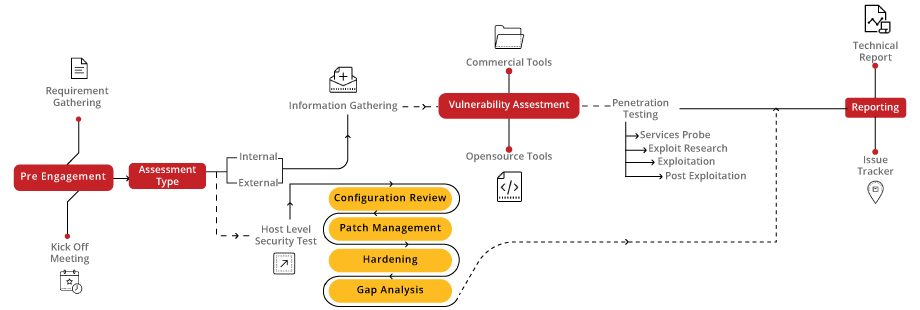
Assessment Process
A structured, repeatable methodology delivering consistent, high-quality results across every engagement.
Learn More About Network Security Assessment
Download our comprehensive flyer and real-world case study to share with your team and stakeholders.
Standards & Frameworks We Cover
Why Choose Us for Network Security Assessment
India's Only CREST-Approved for VA & PT
International gold standard in security testing - the only Indian company with dual CREST accreditation for both Vulnerability Assessment and Penetration Testing.
Vulnerabilities Discovered
Proven track record across 5,500+ assessments. Every finding is manually validated with proof-of-concept - zero false positives.
Real-Time Project Portal
Track assessment progress, view findings, and collaborate with our team through our proprietary LURA platform. Security Simplified.
Frequently Asked Questions
Get clear answers to common questions about our Network Security Assessment process.
How long does the Network Security Assessment take?
Typically 1-3 weeks depending on scope and complexity. We provide a detailed timeline during the scoping phase based on your specific environment and requirements.
Will the assessment affect our production systems?
We use carefully controlled, non-destructive testing techniques for production environments. For invasive tests, we coordinate timing with your team and can test on staging environments.
What certifications do your testers hold?
Our team holds OSCP, CREST CRT, CEH, CISSP, and CISM certifications. Briskinfosec is CREST-approved for both Vulnerability Assessment and Penetration Testing - the only Indian company with this dual accreditation.
Do you provide re-testing after remediation?
Yes. We include one round of complimentary re-testing within 90 days to validate all findings have been properly remediated. The re-test report is provided through our LURA portal.
What deliverables do we receive?
You receive a comprehensive report with executive summary, detailed technical findings with CVSS scores, proof-of-concept demonstrations, risk-prioritized remediation guidance, and access to our LURA portal for ongoing tracking.