Web Application Security Assessment (VAPT)
Comprehensive web application vulnerability assessment and penetration testing. OWASP Top 10, business logic, authentication bypass, session management, and API security. CREST-approved methodology.

Why Web Application Security Assessment (VAPT) Matters
Every organization faces these critical risks. Without proper assessment, these vulnerabilities become attack vectors for adversaries.
SQL Injection & Cross-Site Scripting (XSS)
Injection attacks remain the #1 web vulnerability. We test for blind SQLi, second-order injection, stored/reflected XSS, and DOM-based XSS using both automated tools and manual payloads.
Authentication & Session Management Flaws
Weak password policies, insecure session tokens, missing multi-factor, and session fixation vulnerabilities that give attackers unauthorized access to user accounts.
Business Logic Vulnerabilities
Flaws in application workflow - price manipulation, privilege escalation through workflow bypass, race conditions in transactions, and multi-step process abuse.
Insecure Direct Object References (IDOR)
Unauthorized access to data by manipulating object identifiers. We test every parameter for horizontal and vertical privilege escalation across all user roles.
Server-Side Request Forgery (SSRF)
Exploiting server-side requests to access internal services, cloud metadata endpoints, and backend systems not exposed to the internet.
Insecure Deserialization
Manipulating serialized objects to achieve remote code execution, privilege escalation, or injection attacks through unsafe deserialization in Java, .NET, PHP, and Python.
What We Assess
A comprehensive, methodical evaluation covering every critical surface area.
Deep-Dive Coverage - Every Nuance Addressed
Web Application Security Assessment (VAPT) isn't one-size-fits-all. Different contexts demand different assessment approaches. We go beyond generic checklists to address the specific attack surfaces and risks of each domain.
Modern Authentication & Authorization Logic Abuse
Assessment of identity flows that fail under real adversary behavior, especially in federated, multi-tenant, and step-up authentication scenarios. The focus is on logic flaws that bypass strong controls without relying on noisy exploit signatures.
- ▸ OAuth 2.0 PKCE downgrade, redirect_uri mix-up, and authorization code interception edge cases
- ▸ OIDC token substitution, nonce replay, and trust confusion between front-channel and back-channel flows
- ▸ IDOR and BOLA through UUID predictability, GraphQL node enumeration, or insecure object mapping
- ▸ SAML assertion consumer service tampering, RelayState abuse, and signature wrapping validation gaps
- ▸ MFA bypass through recovery flow desynchronization, step-up authentication gaps, or device trust abuse
Client-Side Attack Surface Validation
Modern web applications carry significant risk in the browser layer, where frameworks, third-party scripts, and storage APIs create exploitable trust boundaries. Testing goes beyond reflected XSS to include state manipulation and browser-resident persistence paths.
- ▸ DOM XSS in SPA hydration gaps, client-side templating sinks, and unsafe use of innerHTML or dangerous render helpers
- ▸ Prototype pollution leading to gadget discovery in bundled JavaScript and privilege changes in application state
- ▸ Service worker cache poisoning, offline storage tampering, and hostile update persistence in PWA deployments
- ▸ postMessage origin confusion across embedded widgets, payment frames, and cross-subdomain integrations
- ▸ CSP bypass through JSONP endpoints, nonce reuse, Trusted Types gaps, or third-party script trust abuse
Server-Side Execution & Parser Abuse
This domain targets the deep exploit primitives that convert parsing mistakes into code execution, sensitive network reachability, or proxy desynchronization. It is especially relevant for layered deployments using reverse proxies, templating engines, and file-processing pipelines.
- ▸ Insecure Java, PHP, or .NET deserialization gadget chains reachable through session, API, or queue inputs
- ▸ Template injection in Jinja2, Twig, Velocity, Freemarker, or Razor rendering paths
- ▸ SSRF to cloud metadata services, internal admin panels, and service discovery endpoints from server-side fetch features
- ▸ Polyglot file upload abuse leading to parser confusion, antivirus bypass, or image processing RCE
- ▸ HTTP request smuggling variants such as CL.TE, TE.CL, and hop-by-hop header confusion across proxy chains
Business Workflow Abuse & Fraud Paths
Many of the highest-impact web flaws are not classic injection issues but failures in state management, pricing logic, and transactional trust. This testing models how attackers monetize small logic weaknesses into account takeover, fraud, or unauthorized data access.
- ▸ Price tampering across cart, checkout, tax, and payment gateway state transitions
- ▸ Coupon stacking, refund replay, and race conditions in wallet or loyalty point redemption flows
- ▸ Multi-tenant administration abuse through broken workflow segregation and weak approval boundaries
- ▸ Password reset and account recovery sequencing flaws that permit takeover without primary factor knowledge
- ▸ Webhook signature validation bypass on order, payout, or subscription state change events
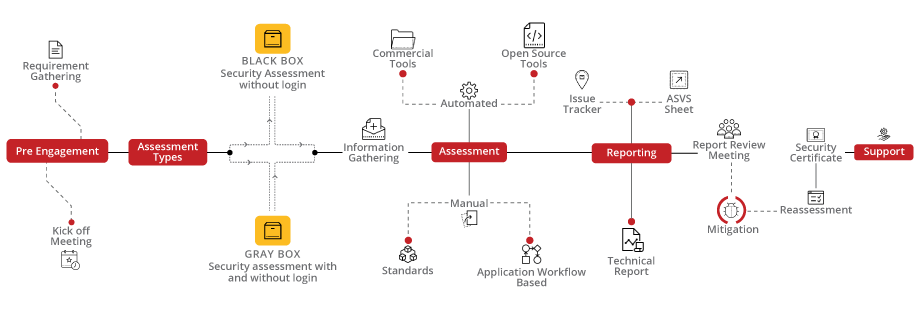
Assessment Process
A structured, repeatable methodology delivering consistent, high-quality results across every engagement.
Learn More About Web Application Security Assessment (VAPT)
Download our comprehensive flyer and real-world case study to share with your team and stakeholders.
Standards & Frameworks We Cover
Why Choose Us for Web Application Security Assessment (VAPT)
India's Only CREST-Approved for VA & PT
International gold standard in security testing - the only Indian company with dual CREST accreditation for both Vulnerability Assessment and Penetration Testing.
Vulnerabilities Discovered
Proven track record across 5,500+ assessments. Every finding is manually validated with proof-of-concept - zero false positives.
Real-Time Project Portal
Track assessment progress, view findings, and collaborate with our team through our proprietary LURA platform. Security Simplified.
Frequently Asked Questions
Clear answers to help you make informed security decisions for your organization.
How long does the Web Application Security Assessment (VAPT) take?
Typically 1-3 weeks depending on scope and complexity. We provide a detailed timeline during the scoping phase based on your specific environment and requirements.
Will the assessment affect our production systems?
We use carefully controlled, non-destructive testing techniques for production environments. For invasive tests, we coordinate timing with your team and can test on staging environments.
What certifications do your testers hold?
Our team holds OSCP, CREST CRT, CEH, CISSP, and CISM certifications. Briskinfosec is CREST-approved for both Vulnerability Assessment and Penetration Testing - the only Indian company with this dual accreditation.
Do you provide re-testing after remediation?
Yes. We include one round of complimentary re-testing within 90 days to validate all findings have been properly remediated. The re-test report is provided through our LURA portal.
What deliverables do we receive?
You receive a comprehensive report with executive summary, detailed technical findings with CVSS scores, proof-of-concept demonstrations, risk-prioritized remediation guidance, and access to our LURA portal for ongoing tracking.