Mobile Application Security Testing
Android and iOS application security assessment - reverse engineering, runtime manipulation, data storage analysis, network communication testing, and backend API security. OWASP MASTG methodology.

Why Mobile Application Security Testing Matters
Every organization faces these critical risks. Without proper assessment, these vulnerabilities become attack vectors for adversaries.
Insecure Local Data Storage
Sensitive data stored in SharedPreferences, Keychain misuse, SQLite databases, and cache files without encryption. We extract and analyze every data storage mechanism on the device.
Reverse Engineering & Code Tampering
Decompiling APK/IPA to extract hardcoded secrets, API keys, and business logic. We assess obfuscation effectiveness and anti-tampering mechanisms against real-world reverse engineering.
Insecure Network Communication
Missing certificate pinning, weak TLS configuration, and unencrypted API calls. We intercept and analyze all network traffic for man-in-the-middle vulnerabilities.
Authentication & Session Vulnerabilities
Weak biometric implementation, insecure session management, missing token expiration, and OAuth mobile flow vulnerabilities enabling unauthorized account access.
Runtime Manipulation (Frida/Objection)
Hooking into running applications to bypass security controls, modify behavior, manipulate financial transactions, and extract runtime secrets using dynamic instrumentation.
Backend API Exploitation
Mobile apps often have weaker API security than web counterparts. We test the entire backend API surface from the mobile client perspective for BOLA, injection, and logic flaws.
What We Assess
A comprehensive, methodical evaluation covering every critical surface area.
Deep-Dive Coverage - Every Nuance Addressed
Mobile Application Security Testing isn't one-size-fits-all. Different contexts demand different assessment approaches. We go beyond generic checklists to address the specific attack surfaces and risks of each domain.
Runtime Instrumentation & Tamper Resistance
Real-world attackers instrument mobile apps dynamically, so testing must assume full device control on rooted or jailbroken platforms. We measure whether anti-tamper controls meaningfully raise attacker cost.
- ▸ Frida detection bypass and anti-hook evasion across Java, JNI, Swift, and Objective-C layers
- ▸ SSL pinning bypass using runtime method interception and certificate store manipulation
- ▸ Root/Jailbreak detection bypass through filesystem and environment spoofing
- ▸ Application repackaging and signature stripping resilience testing
Mobile Backend Abuse & Session Handling
The mobile client frequently exposes backend assumptions that do not appear in browser testing. We focus on how mobile-specific authentication and token models can be abused.
- ▸ Hardcoded API keys, Firebase configuration, and service secrets extraction
- ▸ Refresh token abuse, device binding bypass, and session cloning
- ▸ Insecure deep link and universal link handling into authenticated states
- ▸ BOLA and workflow abuse in mobile-only REST or GraphQL endpoints
Local Data Protection & Device Exposure
Sensitive mobile risk often comes from what the app leaves behind on the device. We check if handset compromise translates into user or enterprise data theft.
- ▸ Plaintext SQLite, Realm, shared preferences, or plist storage of PII
- ▸ Android exported activities and receivers enabling intent hijack
- ▸ iOS Keychain misconfiguration and insecure accessibility classes
- ▸ Clipboard, screenshot, cache, and log leakage of secrets
Secure Platform Integration Testing
Mobile apps depend on platform security features like biometrics and passkeys. We verify these integrations are implemented as strong controls.
- ▸ WebView JavaScript bridge exposure and XSS in embedded flows
- ▸ Biometric fallback abuse and logic flaws in BiometricPrompt handling
- ▸ Passkey and FIDO2 registration rebind and recovery edge cases
- ▸ App attestation and device integrity trust validation gaps
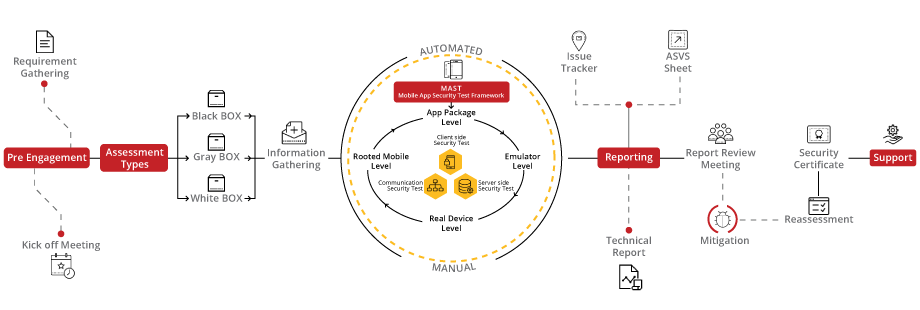
Assessment Process
A structured, repeatable methodology delivering consistent, high-quality results across every engagement.
Learn More About Mobile Application Security Testing
Download our comprehensive flyer and real-world case study to share with your team and stakeholders.
Standards & Frameworks We Cover
Why Choose Us for Mobile Application Security Testing
India's Only CREST-Approved for VA & PT
International gold standard in security testing - the only Indian company with dual CREST accreditation for both Vulnerability Assessment and Penetration Testing.
Vulnerabilities Discovered
Proven track record across 5,500+ assessments. Every finding is manually validated with proof-of-concept - zero false positives.
Real-Time Project Portal
Track assessment progress, view findings, and collaborate with our team through our proprietary LURA platform. Security Simplified.
Frequently Asked Questions
Clear answers to help you make informed security decisions for your organization.
How long does the Mobile Application Security Testing take?
Typically 1-3 weeks depending on scope and complexity. We provide a detailed timeline during the scoping phase based on your specific environment and requirements.
Will the assessment affect our production systems?
We use carefully controlled, non-destructive testing techniques for production environments. For invasive tests, we coordinate timing with your team and can test on staging environments.
What certifications do your testers hold?
Our team holds OSCP, CREST CRT, CEH, CISSP, and CISM certifications. Briskinfosec is CREST-approved for both Vulnerability Assessment and Penetration Testing - the only Indian company with this dual accreditation.
Do you provide re-testing after remediation?
Yes. We include one round of complimentary re-testing within 90 days to validate all findings have been properly remediated. The re-test report is provided through our LURA portal.
What deliverables do we receive?
You receive a comprehensive report with executive summary, detailed technical findings with CVSS scores, proof-of-concept demonstrations, risk-prioritized remediation guidance, and access to our LURA portal for ongoing tracking.