Introduction
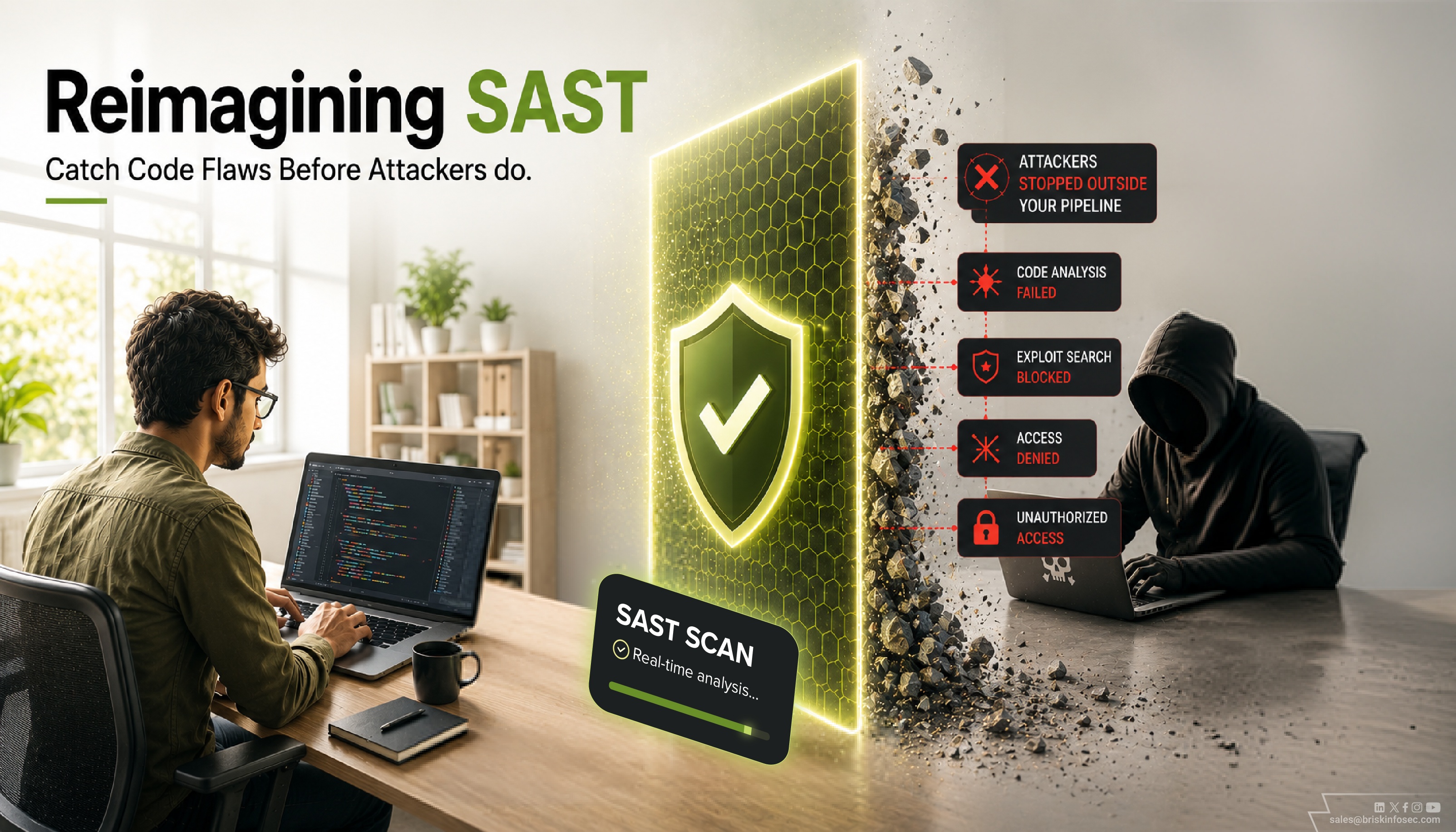
Static Application Security Testing has been the unloved cousin of the cybersecurity programme for years. Compliance teams insisted on it. Developers tolerated it. Security teams complained about its false positives. Everyone agreed it mattered and nobody quite trusted it. That posture is now dangerous.
The same analysis that SAST tools perform on a code base, adversaries can now perform autonomously, faster, and with the explicit objective of finding chain-ready flaws that turn a minor bug into a genuine breach. The race to be the first reader of your own code is no longer optional. It is the job.
Why the SAST Equation Has Changed
Three shifts have compounded on each other and none can be addressed in isolation.
Adversarial AI has closed the detection gap - The time between a developer merging a vulnerable function and an automated system identifying and exploiting it has shortened significantly. A quarterly SAST scan was always a lagging indicator; in the current environment it is a dangerously slow one.
The threat model has shifted to chain-ready patterns - A flaw that looks trivial in isolation becomes critical the moment it connects to two other small weaknesses. SAST tools that flag individual vulnerabilities without understanding how they combine are solving the wrong version of the problem.
Remediation speed now matters more than detection speed -The window between vulnerability disclosure and active exploitation has collapsed. The metric that matters is no longer scan count. It is fix rate. That is the number adversaries are racing against, and it should be the number the board sees.
Where Most Indian Enterprises Are Weak
Three weaknesses recur consistently across Indian enterprise SAST programmes regardless of sector or size.
First, SAST is run by the security team but findings sit unread by engineering. The handoff between who discovers the issue and who fixes it is broken before it starts. This is an organisational design problem, not a tooling problem. No scanner closes a handoff gap that exists because security and engineering operate with different incentives and different definitions of done.
Second, the tool generation is outdated. Many Indian enterprises are still running scanners that pre-date AI-augmented analysis. These tools produce false-positive rates high enough that developers have rationally learned to ignore them. A scanner that flags noise on every pull request is not a security control.
Third, open-source dependencies go uncovered. Industry data confirms that 42 percent of developer-produced code now has AI-assistance, projected to reach 65 percent by 2027. The dependency surface and the AI-assistance surface are both growing simultaneously. A scanner that reviews only first-party code is reviewing a shrinking fraction of what reaches production.
What Modern SAST Must Look Like
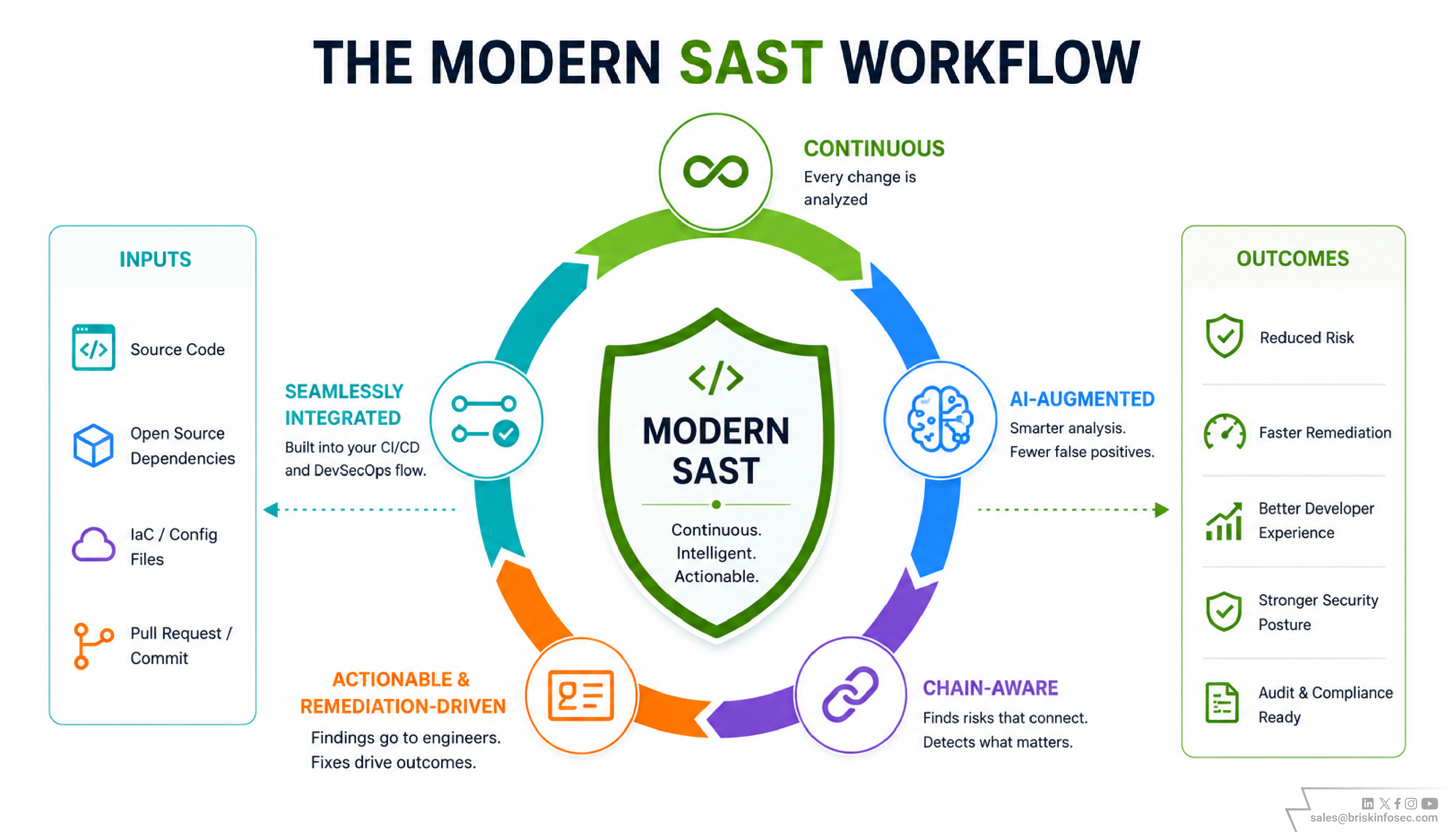
Four properties define a programme built for the current threat environment.
- Continuous and pipeline-integrated - Every pull request is scanned. Every merge is gated by severity threshold. Findings reach the developer while the code context is still fresh.
- AI-augmented with reduced false-positive noise - Modern AI-augmented scanners apply machine learning to triage, ensuring what reaches the developer is actionable rather than noise.
- Chain-aware - The scanner must identify not just individual flaws but patterns that combine into exploitable sequences. A minor input-validation gap feeding into an authentication bypass adjacent to an admin endpoint is one critical chain, not three minor findings.
- Tied to remediation with engineering-facing outputs - Findings flow into engineering tickets with severity tags, code-path attribution, and SLAs. Compliance becomes the side effect. Operational hardening is the goal.
Legacy SAST Vs Modern SAST
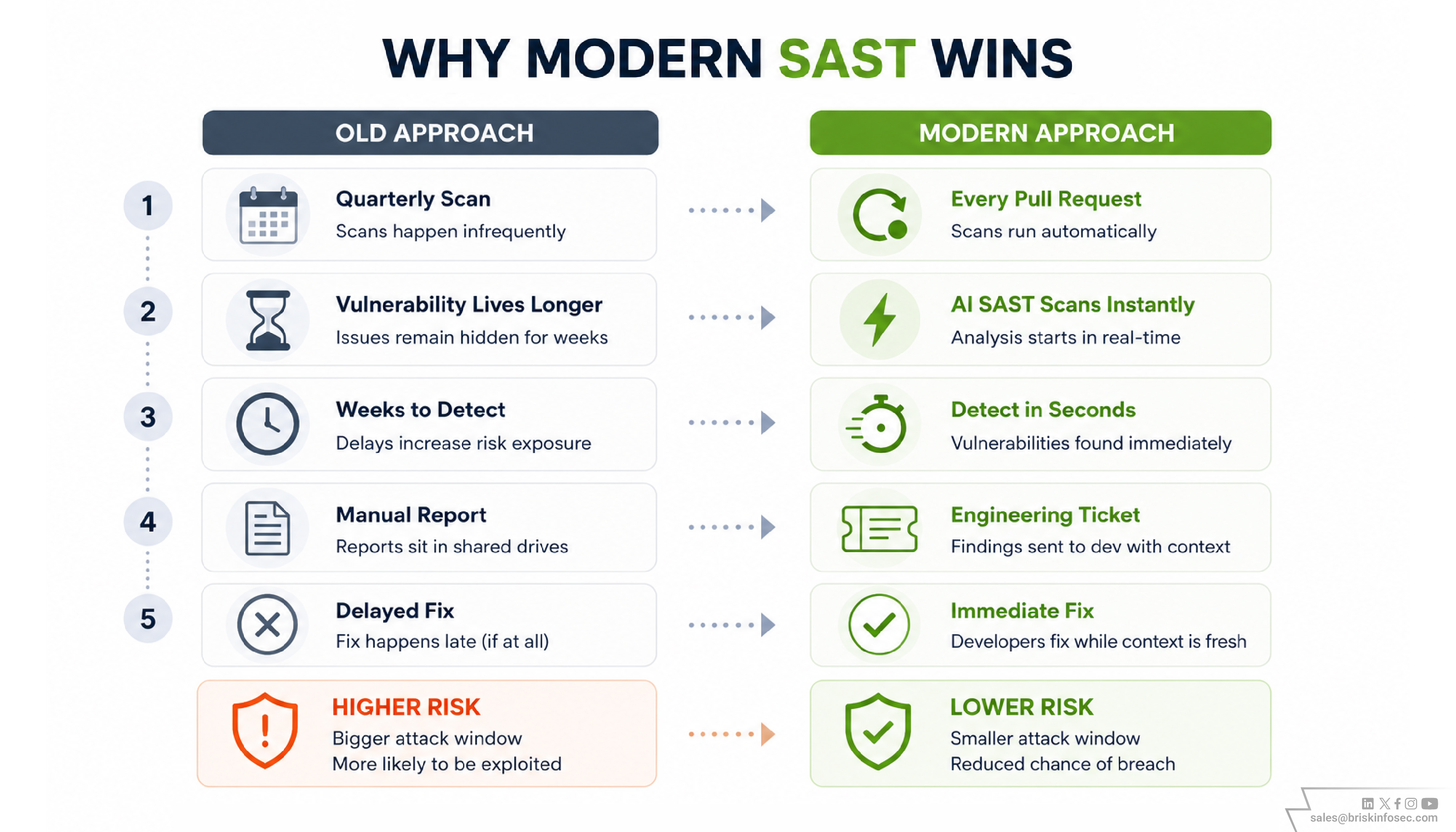
| Property | Legacy SAST | Modern SAST |
| Cadence | Quarterly scan | Every pull request |
| Coverage | First-party code only | First-party, dependencies, and IaC |
| False-Positive Rate | High; often ignored | Tuned and actionable |
| Integration | Standalone tool | Embedded in CI/CD pipeline |
| Remediation Tracking | Spreadsheet or shared drive | Engineering tickets with SLAs |
| Outcome | Compliance artefact | Operational defence |
Real-World Scenario: The Remediation Rate Transformation
CASE STUDY | B2B SaaS Company, India
Before switching to a modern pipeline-integrated programme, the security team filed SAST findings into a shared drive that engineering rarely opened. No SLA. No ticket attribution. Remediation rate on critical findings: 12 percent.
After switching to a system where findings flowed directly into the engineering ticketing system with severity tags and code-path attribution, the remediation rate on critical findings rose to 78 percent within six months. The total number of findings did not change. What changed was who received them, when, and with how much context.
The CISO's quarterly board update changed character entirely. Previous quarters reported scan counts. New quarters reported fix rates. The audit committee preferred the new format. Boards do not fund scanning. They fund evidence that things actually get fixed.
Best Practices and Recommendations
For CISOs and Board-Level Stakeholders
- Reframe the board metric. Replace scan counts with fix rates and mean time to remediate. These are the numbers that correlate with actual risk reduction and that regulators want to see evidenced.
- Fund the organisational fix before the tooling fix. If security and engineering do not share ticket systems and SLA accountability, a better scanner will not move the remediation rate. Structural alignment between teams comes first.
- Treat a documented SAST programme as DPDPA evidence. A continuously operating SAST programme with documented fix rates is strong practical evidence of reasonable security safeguards under the DPDPA. Regulators want to see that you fix, not just that you scan.
For CTOs and Engineering Leaders
- Evaluate your scanner generation honestly. If your current tool produces false-positive rates high enough that developers skip the findings queue, it is not a control. Evaluate AI-augmented alternatives on actionable findings per scan, not on feature lists.
- Ask vendors the right evaluation question. Where exactly does your AI run: in detection, or in triage and remediation? AI applied to triage on top of a proven rule-based detection engine is the more defensible starting point in 2026 than AI-native detection alone, which lacks years of benchmark validation.
- Pair SCA with SAST as a mandatory combination. Software Composition Analysis covers the open-source dependency surface that SAST does not reach. Any platform that does not bundle both should be treated as incomplete coverage.
For Developers and Engineering Teams
- Treat a clean SAST scan as a floor, not a ceiling. A passing scan means your code does not contain known-bad patterns. Business-logic vulnerabilities and architecture-level design flaws still require human review at the design stage.
- Engage chain-aware findings as critical regardless of individual severity rating. When a finding references a pattern across multiple code paths, the chain view is the threat actor's view. Act on it accordingly.
Briskinfosec LuraInsight: Our AI-augmented code-security platform for regulated, sovereignty-conscious enterprises. LuraInsight runs fully offline and air-gapped, so code never leaves your network, unifying SAST, SCA, SBOM and CBOM (post-quantum crypto inventory) in a single scan. Powered by our own purpose-trained security model, not a third-party cloud LLM, it means no per-request fees and no code logged or sent out. Lower false-positive noise, with findings engineers can act on. Available standalone or bundled with VAPT and bSOC retainers.
Future Considerations
By 2027, the balance of SAST evaluation weight will likely shift toward AI-primary detection with rule-based verification, as models continue to improve at contextual code reasoning. Enterprises running mature AI-augmented programmes today are building the operational baseline that will make that transition defensible.
The growth of AI-assisted code generation also changes the SAST surface in ways not yet fully understood. Tools trained primarily on human-authored vulnerability patterns may have coverage gaps for AI-generated code. Early adoption of chain-aware, AI-augmented analysis is a hedge against this evolving unknown, not just an improvement on a known problem.
Conclusion
Static analysis used to be a checkbox. Now it is a race. Move from quarterly scans to pipeline-integrated, AI-augmented analysis this quarter. Pair SAST with Software Composition Analysis. Tie findings to engineering tickets with real SLAs. Measure fix rates and report them to the board. Tools like Briskinfosec's LuraInsight are built precisely for this operating model, delivering chain-aware, low-noise findings directly into engineering workflows for Indian enterprises.
The first reader of your code should be you. The second should be your tooling. Not the adversary.
Frequently Asked Questions
1. Will modern SAST replace penetration testing?
No. SAST finds flaws in code; penetration testing finds flaws in deployment, configuration, and runtime integration. Both are required and neither substitutes for the other.
2. How does SAST relate to DPDPA compliance?
Indirectly but meaningfully. DPDPA does not name SAST specifically, but a documented, continuously running programme with fix-rate evidence is strong practical proof of reasonable security safeguards under the law's broader expectations.
3. Does SAST cover open-source dependencies?
Not on its own. Software Composition Analysis must be paired with SAST to cover third-party and open-source libraries. Most modern platforms, including LuraInsight, bundle both in a single scan.
4. Is AI SAST the same across every vendor?
No. Some platforms apply AI only to triage and remediation while keeping traditional rule-based detection; others use AI as the primary detection method. Ask vendors exactly where their AI runs before signing a contract.
5. As a developer, what changes day-to-day?
Expect findings as tickets within your existing workflow on every pull request, attributed to your code path with context attached, rather than in a quarterly PDF about code you may have already rewritten.