Experiencing a Security Incident? → 24/7 Response: +91 73059 79248
Briskinfosec
COMPANY
About Briskinfosec Scope My Security Program Our Clients Testimonials Careers Partnership
INDUSTRIES
Banking & Financial Services Healthcare Manufacturing Government Energy & Utilities Telecom Technology Retail & E-Commerce All Industries →
CONNECT
Contact Us Request Assessment Responsible Disclosure Client Certificate Verification Training Certificate Verification
SECURITY TESTING (VAPT)
Web Application VAPT Mobile App Security API Security Testing Cloud Security Assessment Network Security Audit IoT Penetration Testing OT/SCADA Security Database Penetration Wireless Security CREST VAPT
ADVANCED ASSESSMENT
Red Team Operations AI/LLM Security Audit Digital Forensics Cyber Intelligence Secure Code Review DevSecOps Hardware Security Thick Client Security Host Level Security Automotive VAPT Telecom VAPT
DATA & PRIVACY
Data Security Audit Data Privacy Audit Data Masking & Privacy DSPM Data Breach Simulation SBOM & SCA Website Security All Assurance Services →
COMPLIANCE FRAMEWORKS
ISO 27001:2022 SOC 2 PCI-DSS HIPAA GDPR DPDPA NIST CSF IRDAI ISO 22301 (BCP) ISO 42001 (AI) IEC 62443 (OT) ISO 21434 (Automotive) PDPL (Saudi)
GRC SERVICES
GRC Framework Cyber Risk Assessment Third-Party Risk (TPRM) Data Privacy Compliance Data Retention Policy National Security Compliance Cybersecurity Insurance All Compliance →
GOVERNANCE LAYER
Data Governance Security Posture Management Cybersecurity Maturity AI Maturity Assessment Cyber Resilience BCP/DR Planning vIT Compliance Business Impact Analysis
MANAGED SECURITY
Managed Security (MSSP) SOC as a Service V-CISO Incident Response Virtual Security Team Third Eye (Surveillance)
CONTINUOUS MONITORING
SOAR Integration Security Monitoring Threat Intelligence Platform Cyber Threat Intelligence Lateral Movement Detection Penetration Test as Service
DEFENSIVE OPS
Perimeter Security Access Control Review Cloud Config Review CDN Security Network Architecture Cloud Security Management Virtualization Security All MSSP Services →
ELITE ASSESSMENTS
Threat Modeling Ransomware Readiness Threat & Vulnerability Mgmt Military Grade Review Hacker's POV Assessment
HUMAN LAYER
Security Awareness Training Phishing Simulation Tabletop Exercise Secure Code Training Cybersecurity Culture Cybersec Leadership Incident Response Training Data Privacy Training
STRATEGIC SERVICES
Application Security Governance Quarterly AppSec Review Minimum Security Baseline Secure SDLC Cyber Sense Plan Integration Threat Analysis Infra Risk Assessment Web Extensions Security bSAFE Security Score Layered Security Philosophy All Maturity Services →
PLATFORMS
LURA Portal LuraInsight (SAST) bSAFE Score BriskBox All Products →
Staffing
LEARN
Blog Videos Case Studies Press Room
INTELLIGENCE
Threatsploit Reports Security Essentials Carousel Flyers & Downloads All Resources →
Briskinfosec is a CREST accredited cybersecurity firm, globally recognized for penetration testing and VAPT services Briskinfosec is a CERT-In empanelled cybersecurity company based in Chennai with global operations in Dubai
Get Your bSafe Score →
Briskinfosec
COMPANY
About Briskinfosec Scope My Security Program Our Clients Testimonials Careers Partnership
INDUSTRIES
Banking & Financial Services Healthcare Manufacturing Government Energy & Utilities Telecom Technology Retail & E-Commerce All Industries →
CONNECT
Contact Us Request Assessment Responsible Disclosure Client Certificate Verification Training Certificate Verification
SECURITY TESTING (VAPT)
Web Application VAPT Mobile App Security API Security Testing Cloud Security Assessment Network Security Audit IoT Penetration Testing OT/SCADA Security Database Penetration Wireless Security CREST VAPT
ADVANCED ASSESSMENT
Red Team Operations AI/LLM Security Audit Digital Forensics Cyber Intelligence Secure Code Review DevSecOps Hardware Security Thick Client Security Host Level Security Automotive VAPT Telecom VAPT
DATA & PRIVACY
Data Security Audit Data Privacy Audit Data Masking & Privacy DSPM Data Breach Simulation SBOM & SCA Website Security All Assurance Services →
COMPLIANCE FRAMEWORKS
ISO 27001:2022 SOC 2 PCI-DSS HIPAA GDPR DPDPA NIST CSF IRDAI ISO 22301 (BCP) ISO 42001 (AI) IEC 62443 (OT) ISO 21434 (Automotive) PDPL (Saudi)
GRC SERVICES
GRC Framework Cyber Risk Assessment Third-Party Risk (TPRM) Data Privacy Compliance Data Retention Policy National Security Compliance Cybersecurity Insurance All Compliance Services →
GOVERNANCE LAYER
Data Governance Security Posture Management Cybersecurity Maturity AI Maturity Assessment Cyber Resilience BCP/DR Planning vIT Compliance Business Impact Analysis
MANAGED SECURITY
Managed Security (MSSP) SOC as a Service V-CISO Incident Response Virtual Security Team Third Eye (Surveillance)
CONTINUOUS MONITORING
SOAR Integration Security Monitoring Threat Intelligence Platform Cyber Threat Intelligence Lateral Movement Detection Penetration Test as Service
DEFENSIVE OPS
Perimeter Security Access Control Review Cloud Config Review CDN Security Network Architecture Cloud Security Management Virtualization Security
ELITE ASSESSMENTS
Threat Modeling Ransomware Readiness Threat & Vulnerability Mgmt Military Grade Review Hacker's POV Assessment
HUMAN LAYER
Security Awareness Training Phishing Simulation Tabletop Exercise Secure Code Training Cybersecurity Culture Cybersec Leadership Incident Response Training Data Privacy Training
STRATEGIC SERVICES
Application Security Governance Quarterly AppSec Review Minimum Security Baseline Secure SDLC Cyber Sense Plan Integration Threat Analysis Infra Risk Assessment Web Extensions Security bSAFE Security Score → Layered Security Philosophy →
PLATFORMS
LURA Portal LuraInsight (SAST) bSAFE Score BriskBox All Products →
Staffing
LEARN
Blog Videos Case Studies Press Room
INTELLIGENCE
Threatsploit Reports Security Essentials Carousel Flyers & Downloads All Resources →
Home → Blog → Why Human Error is Still Your Biggest Cy...
General

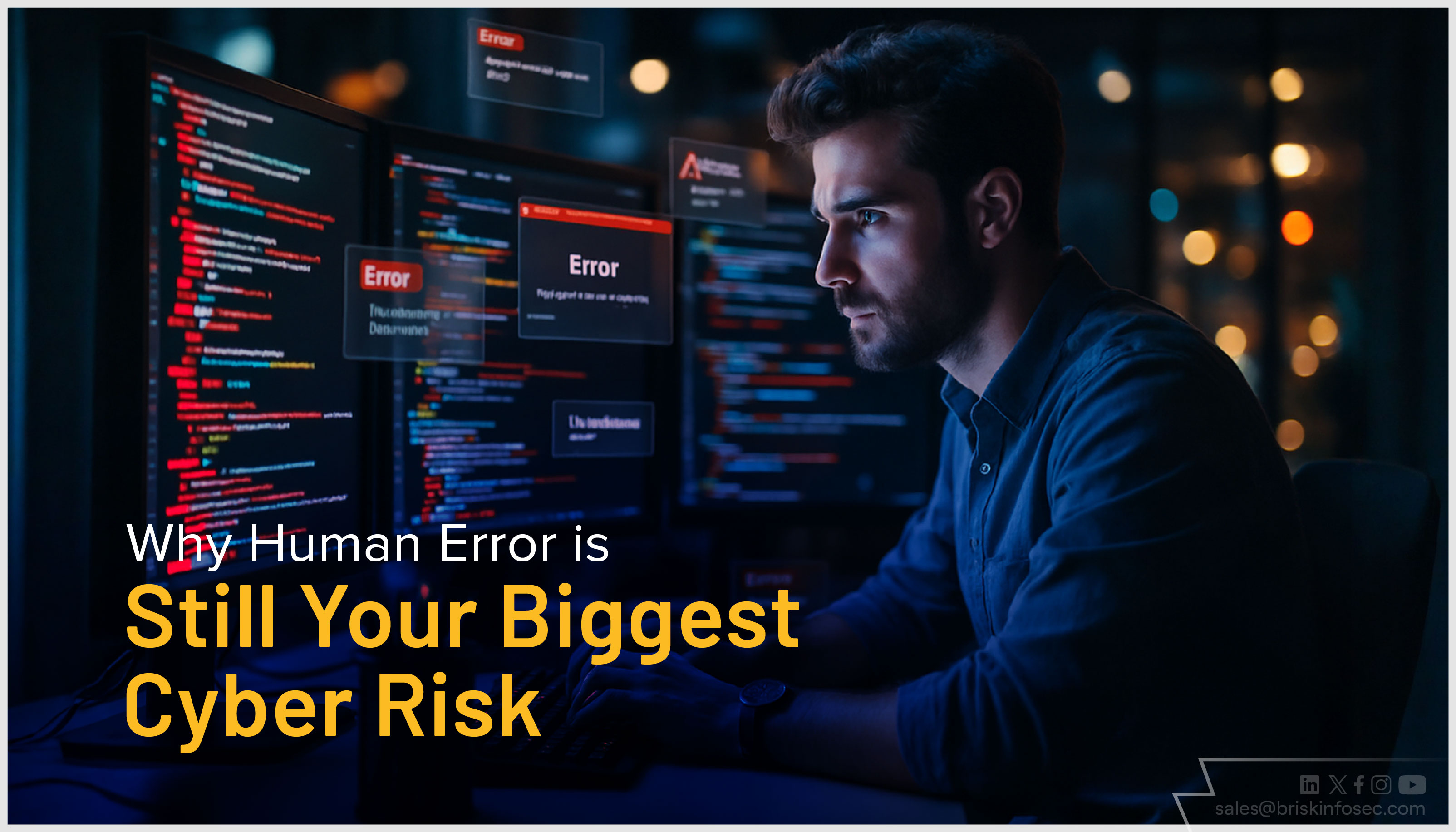
Why Human Error is Still Your Biggest Cyber Risk

August 21, 2025
7 min read
1,262 Views
Contents
Why Human Error is Still Your Biggest Cyber Risk

In 2025, you can have the most advanced firewalls, AI-driven threat detection, and encrypted databases in the world. Yet, this entire multi-million-dollar security stack can be rendered useless by a single, predictable human action: a click. Despite incredible technological advancements, the data is unequivocal: the overwhelming majority of successful cyberattacks, some reports say as high as 95%, begin with a human element.

For C-level executives and board members, this is a sobering reality. It means that your greatest vulnerability is not a flaw in your software, but a feature of human psychology. In a fast-paced, hybrid work environment where employees are bombarded with information, the risk of error is higher than ever.

However, blaming employees for falling victim to increasingly sophisticated, AI-powered attacks is not a strategy. A resilient organization doesn't seek to eliminate human error, an impossible task, but instead builds a robust system of training, technology, and culture to contain its impact. This requires a strategic approach that moves beyond outdated compliance training and turns your biggest risk into your strongest defensive asset. At Briskinfosec, we believe that to Fortify Your Future, you must first fortify your people.

The Modern Face of Human Error: More Than Just a "Careless Click"

Understanding why human error occurs is the first step to mitigating it. In 2025, attackers are not just sending poorly worded emails; they are master manipulators of human psychology, using technology to make their tricks more effective than ever.
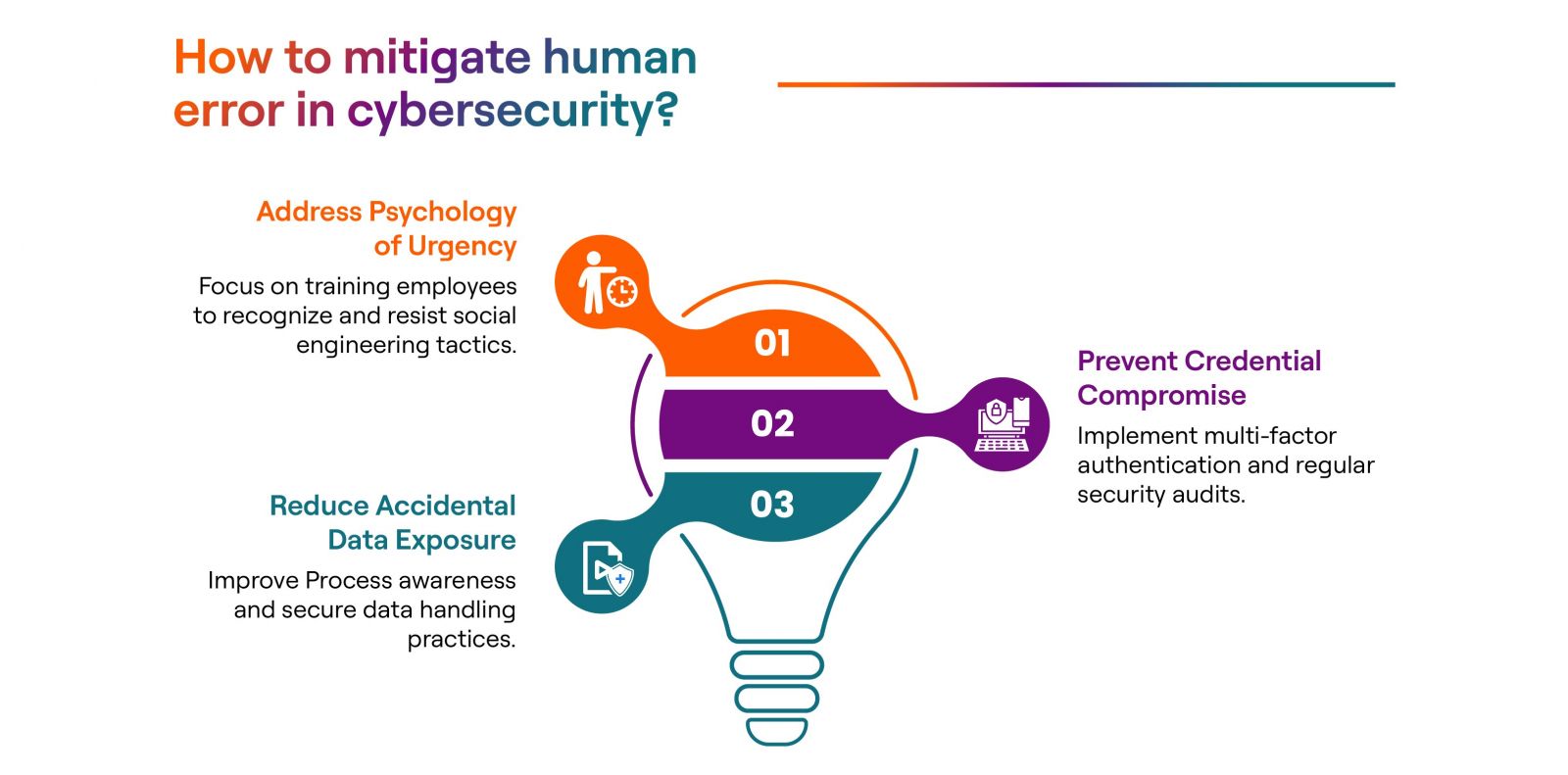
How to mitigate human error in cybersecurity

The Psychology of Urgency and Authority:

Attackers use social engineering to hijack rational thought. They create a false sense of urgency ("This invoice is overdue!"), authority ("This is the CEO, I need you to process this wire transfer immediately"), or scarcity ("This offer expires in 5 minutes!"). AI now allows them to craft these messages with perfect grammar and context, making them incredibly convincing.

The Inevitable Credential Compromise:

This is the most common outcome of a successful phishing attack. An employee, tricked by a clever lure, enters their credentials into a fake login page. With these keys, an attacker can bypass many technical defenses and access sensitive systems, often remaining undetected for months.

Accidental Data Exposure:

Not all human-related breaches are caused by an external attacker. An employee might accidentally share a sensitive file in a public Slack channel, misconfigure a cloud storage setting, or lose an unencrypted company laptop. These are often errors of process and awareness, not malice, but the consequences can be just as severe.

The Flawed Solution: Why "Check-the-Box" Training Fails

For years, the standard response to human risk was a mandatory, once-a-year security awareness training module. We now know this approach is fundamentally broken.

The Boardroom Question: "We train our employees every year. Why do they still click on phishing links?"

The Evidence-Based Answer:

Traditional, compliance-focused training fails because it's boring, generic, and quickly forgotten. It treats employees like a homogenous group and doesn't address the specific threats they face in their roles. A 2019 study confirmed that this type of mandatory training did not meaningfully improve employees' ability to spot malicious emails. It is security theater—an activity that creates the illusion of security while providing little real-world protection.

Building a Resilient Human Firewall: A Certified, Multi-Layered Approach

A truly resilient organization understands that mitigating human risk requires a continuous, multi-layered strategy that combines engaging education, smart technology, and a strong security culture.
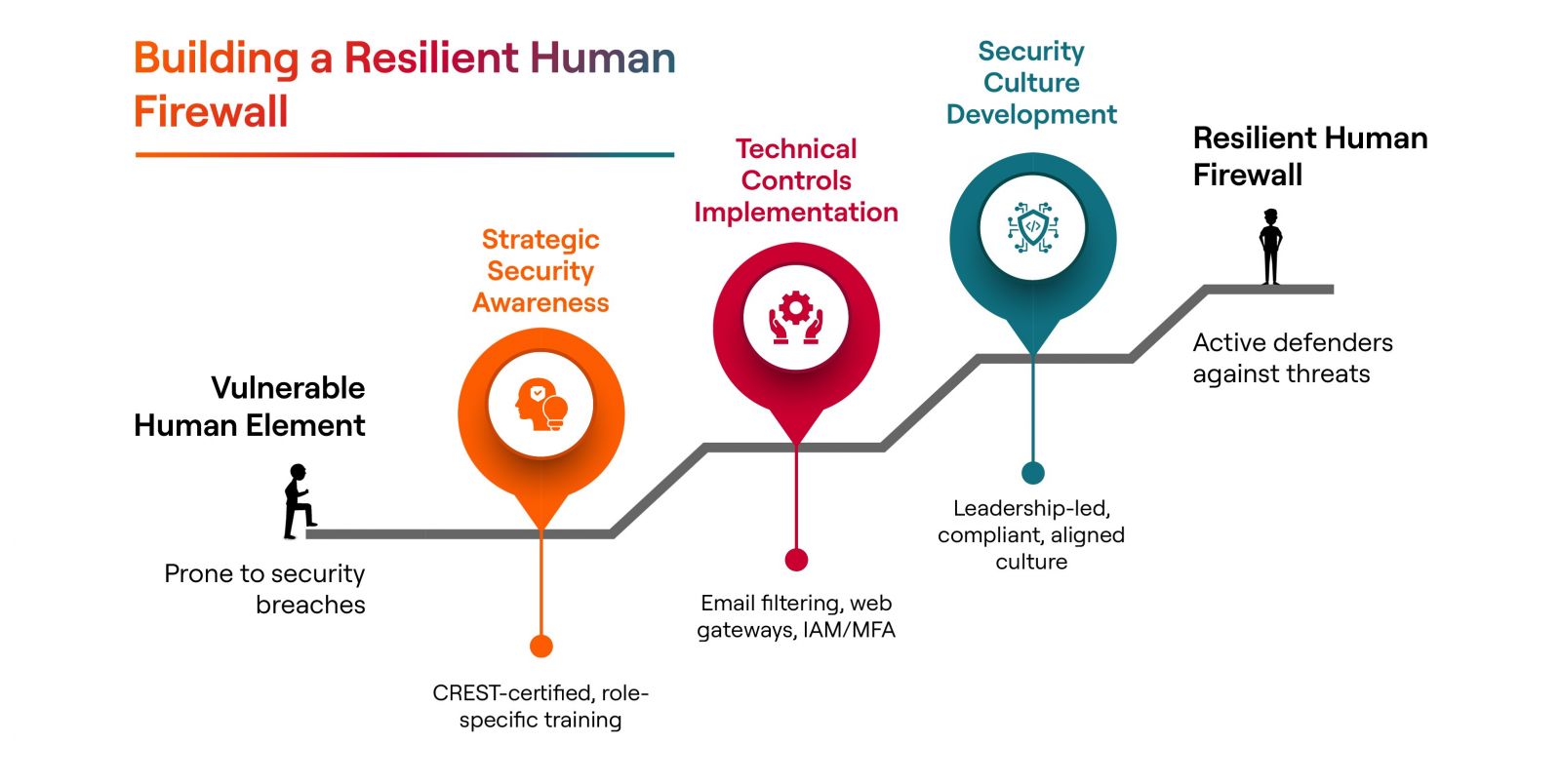
Building a resilient human firewall

Pillar 1: Strategic Security Awareness, Certified for Effectiveness

The CREST-Certified Difference:

Many vendors offer security awareness training, but how do you verify its quality and effectiveness? CREST, a global leader in cybersecurity accreditations, offers a specific certification for Security Awareness and Training providers. Choosing a CREST-certified partner is your assurance that the training program itself, its content, delivery methodology, and effectiveness measurement, has been rigorously vetted against an international standard. It's the difference between a check-box exercise and a genuine behavioral change program.

Our Approach:

We move beyond the one-size-fits-all model. Our certified approach involves:

  • Continuous, Engaging Micro-learning: Short, relevant, and frequent training modules that fit into the modern workflow.
  • Role-Specific Content: A finance department employee faces different threats than a software developer. The training must be tailored to their specific risks.
  • Realistic Phishing Simulations: Safe, controlled simulations that provide immediate feedback, helping employees build the muscle memory to spot real threats.

Pillar 2: Technical Controls as a Critical Safety Net

The Bottom-Line Risk of No Safety Net:

Even the best-trained employee will eventually make a mistake. A resilient security program assumes this and builds a technological safety net to catch them when they fall. This includes robust email filtering to block malicious messages before they arrive, web gateways to prevent access to dangerous sites, and strong Identity and Access Management (IAM) with Multi-Factor Authentication (MFA) to limit the damage of a compromised password.

Our Certified Validation:

A CREST-approved penetration test is essential for validating that these technical safety nets are configured correctly and are truly effective. Our experts will actively try to bypass your email filters and other controls, providing you with real-world assurance that your technology is effectively protecting your people.

Pillar 3: A Security Culture, Led From the Top

A strong security culture begins in the boardroom. When employees see leadership championing security, prioritizing it in decisions, and adhering to policies without exception, they are far more likely to do the same. This cultural foundation transforms employees from potential victims into active defenders.

As a CERT-IN empanelled firm, we have deep experience helping Indian organizations build security cultures that are not only compliant with national directives but are also aligned with local work environments, ensuring the message resonates and sticks.

Measuring What Matters: A Culture of Reporting

The ultimate sign of a successful human risk program isn't a zero-percent click rate on phishing simulations, it's a high percentage of employees reporting suspicious emails. A positive reporting culture means your employees are engaged, vigilant, and have become a distributed network of human threat sensors, your strongest defensive asset.

Conclusion

Human error is an inevitable, constant factor in any organization. A security breach caused by that error, however, is not. In 2025, the organizations that thrive will be those that stop blaming their people and start empowering them. They will move beyond ineffective, check-the-box training and build a resilient human firewall through a strategic, multi-layered program of certified training, validated technology, and a leadership-driven culture of security.

Is your security awareness program creating real behavioral change or just a false sense of security? Schedule a complimentary consultation to discuss how our CREST-certified approach can build a resilient human firewall for your organization.

Frequently Asked Questions

1. What percentage of cyber attacks involve human error?

 According to industry reports, up to 95% of successful cyberattacks begin with a human element, making it the most significant cybersecurity risk factor for organizations in 2025.

2. Why does traditional security awareness training fail?

Traditional annual training fails because it's generic, boring, and quickly forgotten. Studies show compliance-focused training doesn't meaningfully improve employees' ability to identify real threats.

3. What is CREST-certified security awareness training?

CREST certification ensures security awareness programs meet rigorous international standards for content quality, delivery methodology, and effectiveness measurement, providing verified behavioral change outcomes.

4.How can organizations measure human firewall effectiveness?

Success metrics include high suspicious email reporting rates, reduced click rates on realistic phishing simulations, and improved threat identification in role-specific scenarios.

5.What technical controls support human error mitigation?

Essential safety nets include robust email filtering, web gateways, strong Identity and Access Management (IAM), Multi-Factor Authentication (MFA), and validated penetration testing


General
Share this article
A
Written by
Arulselvar Thomas Founder & Director
Cybersecurity expert at Briskinfosec Technology and Consulting, specializing in security assessments, compliance, and helping organizations build resilient security postures.
Recent Blogs
How to Create a Secure AWS IAM Audit User for Cloud Security Assessments
The Cyber Capability Gap Between Mythos, GPT-5.5 and Open-Weight Models Explained
Inside Claude Mythos and What the Indian Defender Actually Needs to Know
Related Services
VAPT Cloud Security Red Team Network Security API Security Mobile App Security
Latest Videos
Navigating Compliance in Cybersecurity Laws, Privacy laws and Your Business
Navigating Compliance in Cybersecurity Laws,...
Apr 26, 2024
Beyond Size: How to Elevate your SOC Cybersecurity Monitoring
Beyond Size: How to Elevate your SOC Cybersec...
Mar 20, 2024
Red Team Assessment
Red Team Assessment
Mar 13, 2024
Get Protected

Discuss your security posture with our certified experts. Get a free initial assessment.

Schedule Free Consultation WhatsApp Us

Related Articles

Phishing Simulation Reveals How Employees Respond to a Fake CEO Email
Apr 29, 2026 · 459
Your Former Employees Still Have Access to Your Systems and Data
Apr 29, 2026 · 519
Your Cyber Insurance Claim May Be Rejected
Apr 20, 2026 · 686
Read Next (Top Blog)
Getting Started with Frida

Ready to Strengthen Your Security?

Talk to our CREST-certified security experts today

WhatsApp Us
Chat instantly with our security team
AI Presales Bot
Get instant answers from LURA AI
Schedule Consultation
Book a free security consultation
Email Us
contact@briskinfosec.com
Link copied to clipboard!
About Us
About Briskinfosec Certin Our Clients Testimonials Press Room
Services
Application Security Mobile App Security Cloud Security Red Team Operations SOC as a Service MSSP All Services →
Compliance
ISO 27001 SOC 2 PCI-DSS GDPR HIPAA All Compliance →
Resources
Blog Videos Case Studies Threatsploit Reports All Resources →
Connect
Careers Partnership Contact Us Responsible Disclosure Terms and Conditions Privacy Policy
India (HQ) Bascon Futura Sv It Park, 12th Floor, 10/2,
Venkatanarayana Rd, T. Nagar, Chennai, Tamil Nadu 600017
+91 73059 79248 · contact@briskinfosec.com
UAE (Dubai) IFZA Business Park, Building A1, Dubai Digital Park,
Dubai Silicon Oasis, Post Box 342001, UAE
contact@briskinfosec.com
Briskinfosec CREST accredited cybersecurity company and globally recognized provider of penetration testing and VAPT services CERT-In empanelled cybersecurity company with headquarters in Chennai and operations in Dubai offering VAPT services Briskinfosec ISO 27001 certified company ensuring robust information security management system Briskinfosec ISO 9001:2015 certified cybersecurity company committed to quality management in India Briskinfosec is a DUNS registered cybersecurity company with a verified global business identity offering VAPT services
© 2026 Briskinfosec Technology & Consulting Pvt Ltd. All rights reserved.
Scope Your Security Program
Chat on WhatsApp Ask LURA AI AI