Experiencing a Security Incident? → 24/7 Response: +91 73059 79248
Briskinfosec
COMPANY
About Briskinfosec Scope My Security Program Our Clients Testimonials Careers Partnership
INDUSTRIES
Banking & Financial Services Healthcare Manufacturing Government Energy & Utilities Telecom Technology Retail & E-Commerce All Industries →
CONNECT
Contact Us Request Assessment Responsible Disclosure Client Certificate Verification Training Certificate Verification
SECURITY TESTING (VAPT)
Web Application VAPT Mobile App Security API Security Testing Cloud Security Assessment Network Security Audit IoT Penetration Testing OT/SCADA Security Database Penetration Wireless Security CREST VAPT
ADVANCED ASSESSMENT
Red Team Operations AI/LLM Security Audit Digital Forensics Cyber Intelligence Secure Code Review DevSecOps Hardware Security Thick Client Security Host Level Security Automotive VAPT Telecom VAPT
DATA & PRIVACY
Data Security Audit Data Privacy Audit Data Masking & Privacy DSPM Data Breach Simulation SBOM & SCA Website Security All Assurance Services →
COMPLIANCE FRAMEWORKS
ISO 27001:2022 SOC 2 PCI-DSS HIPAA GDPR DPDPA NIST CSF IRDAI ISO 22301 (BCP) ISO 42001 (AI) IEC 62443 (OT) ISO 21434 (Automotive) PDPL (Saudi)
GRC SERVICES
GRC Framework Cyber Risk Assessment Third-Party Risk (TPRM) Data Privacy Compliance Data Retention Policy National Security Compliance Cybersecurity Insurance All Compliance →
GOVERNANCE LAYER
Data Governance Security Posture Management Cybersecurity Maturity AI Maturity Assessment Cyber Resilience BCP/DR Planning vIT Compliance Business Impact Analysis
MANAGED SECURITY
Managed Security (MSSP) SOC as a Service V-CISO Incident Response Virtual Security Team Third Eye (Surveillance)
CONTINUOUS MONITORING
SOAR Integration Security Monitoring Threat Intelligence Platform Cyber Threat Intelligence Lateral Movement Detection Penetration Test as Service
DEFENSIVE OPS
Perimeter Security Access Control Review Cloud Config Review CDN Security Network Architecture Cloud Security Management Virtualization Security All MSSP Services →
ELITE ASSESSMENTS
Threat Modeling Ransomware Readiness Threat & Vulnerability Mgmt Military Grade Review Hacker's POV Assessment
HUMAN LAYER
Security Awareness Training Phishing Simulation Tabletop Exercise Secure Code Training Cybersecurity Culture Cybersec Leadership Incident Response Training Data Privacy Training
STRATEGIC SERVICES
Application Security Governance Quarterly AppSec Review Minimum Security Baseline Secure SDLC Cyber Sense Plan Integration Threat Analysis Infra Risk Assessment Web Extensions Security bSAFE Security Score Layered Security Philosophy All Maturity Services →
PLATFORMS
LURA Portal LuraInsight (SAST) bSAFE Score BriskBox All Products →
Staffing
LEARN
Blog Videos Case Studies Press Room
INTELLIGENCE
Threatsploit Reports Security Essentials Carousel Flyers & Downloads All Resources →
Briskinfosec is a CREST accredited cybersecurity firm, globally recognized for penetration testing and VAPT services Briskinfosec is a CERT-In empanelled cybersecurity company based in Chennai with global operations in Dubai
Get Your bSafe Score →
Briskinfosec
COMPANY
About Briskinfosec Scope My Security Program Our Clients Testimonials Careers Partnership
INDUSTRIES
Banking & Financial Services Healthcare Manufacturing Government Energy & Utilities Telecom Technology Retail & E-Commerce All Industries →
CONNECT
Contact Us Request Assessment Responsible Disclosure Client Certificate Verification Training Certificate Verification
SECURITY TESTING (VAPT)
Web Application VAPT Mobile App Security API Security Testing Cloud Security Assessment Network Security Audit IoT Penetration Testing OT/SCADA Security Database Penetration Wireless Security CREST VAPT
ADVANCED ASSESSMENT
Red Team Operations AI/LLM Security Audit Digital Forensics Cyber Intelligence Secure Code Review DevSecOps Hardware Security Thick Client Security Host Level Security Automotive VAPT Telecom VAPT
DATA & PRIVACY
Data Security Audit Data Privacy Audit Data Masking & Privacy DSPM Data Breach Simulation SBOM & SCA Website Security All Assurance Services →
COMPLIANCE FRAMEWORKS
ISO 27001:2022 SOC 2 PCI-DSS HIPAA GDPR DPDPA NIST CSF IRDAI ISO 22301 (BCP) ISO 42001 (AI) IEC 62443 (OT) ISO 21434 (Automotive) PDPL (Saudi)
GRC SERVICES
GRC Framework Cyber Risk Assessment Third-Party Risk (TPRM) Data Privacy Compliance Data Retention Policy National Security Compliance Cybersecurity Insurance All Compliance Services →
GOVERNANCE LAYER
Data Governance Security Posture Management Cybersecurity Maturity AI Maturity Assessment Cyber Resilience BCP/DR Planning vIT Compliance Business Impact Analysis
MANAGED SECURITY
Managed Security (MSSP) SOC as a Service V-CISO Incident Response Virtual Security Team Third Eye (Surveillance)
CONTINUOUS MONITORING
SOAR Integration Security Monitoring Threat Intelligence Platform Cyber Threat Intelligence Lateral Movement Detection Penetration Test as Service
DEFENSIVE OPS
Perimeter Security Access Control Review Cloud Config Review CDN Security Network Architecture Cloud Security Management Virtualization Security
ELITE ASSESSMENTS
Threat Modeling Ransomware Readiness Threat & Vulnerability Mgmt Military Grade Review Hacker's POV Assessment
HUMAN LAYER
Security Awareness Training Phishing Simulation Tabletop Exercise Secure Code Training Cybersecurity Culture Cybersec Leadership Incident Response Training Data Privacy Training
STRATEGIC SERVICES
Application Security Governance Quarterly AppSec Review Minimum Security Baseline Secure SDLC Cyber Sense Plan Integration Threat Analysis Infra Risk Assessment Web Extensions Security bSAFE Security Score → Layered Security Philosophy →
PLATFORMS
LURA Portal LuraInsight (SAST) bSAFE Score BriskBox All Products →
Staffing
LEARN
Blog Videos Case Studies Press Room
INTELLIGENCE
Threatsploit Reports Security Essentials Carousel Flyers & Downloads All Resources →
Home → Blog → Phishing Simulation Reveals How Employee...
General

Phishing Simulation Reveals How Employees Respond to a Fake CEO Email

April 29, 2026
7 min read
462 Views
Contents
Phishing Simulation Reveals How Employees Respond to a Fake CEO Email

Introduction

We ran a phishing simulation to understand how employees respond to a well crafted email that appears to come from their CEO.

We sent one email. It looked like it came from the company’s founder. It said there was an urgent vendor payment needed before end of day. It had no spelling mistakes, used the right logo, referenced a real ongoing project, and was sent from a domain that looked almost identical to the company’s real domain.

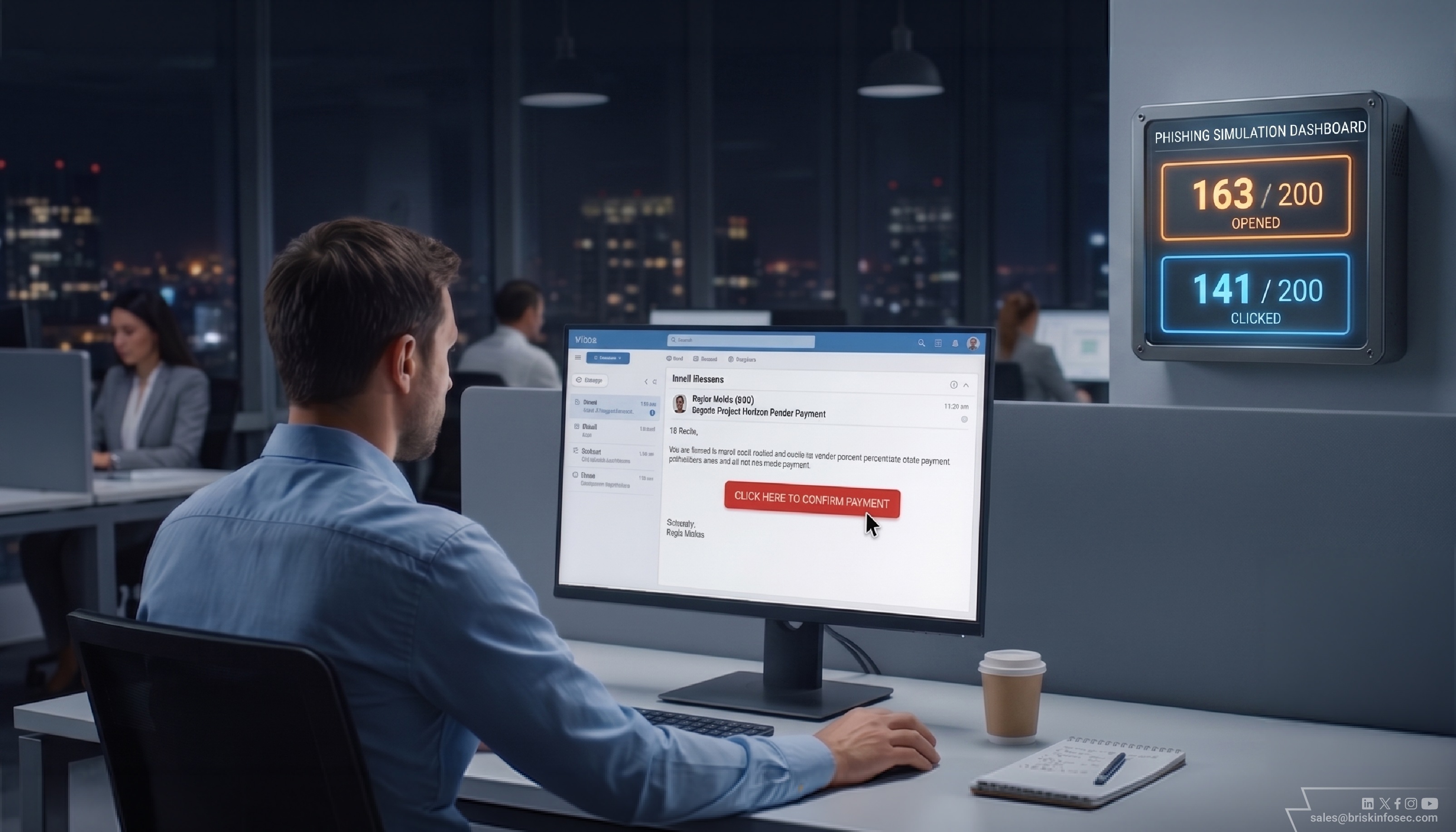
163 out of 200 employees opened it. 141 clicked the link. 68 entered their login credentials.

Here is the part that surprised us most. The people who clicked were not junior staff or recent joiners. They were the finance manager, the operations director, the senior sales head, and department heads who have been with the company for years.

This is not a story about careless employees. It is a story about how a well crafted phishing attack exploits the exact behaviours that make good employees effective at their jobs, including responsiveness, respect for authority, and a desire to get things done.

Exactly What We Sent

Here is the simulation email, reproduced in full. Read it the way your finance team would read it on a busy Tuesday morning, not as someone looking for a phishing attack, but as someone trying to help their CEO before a deadline.
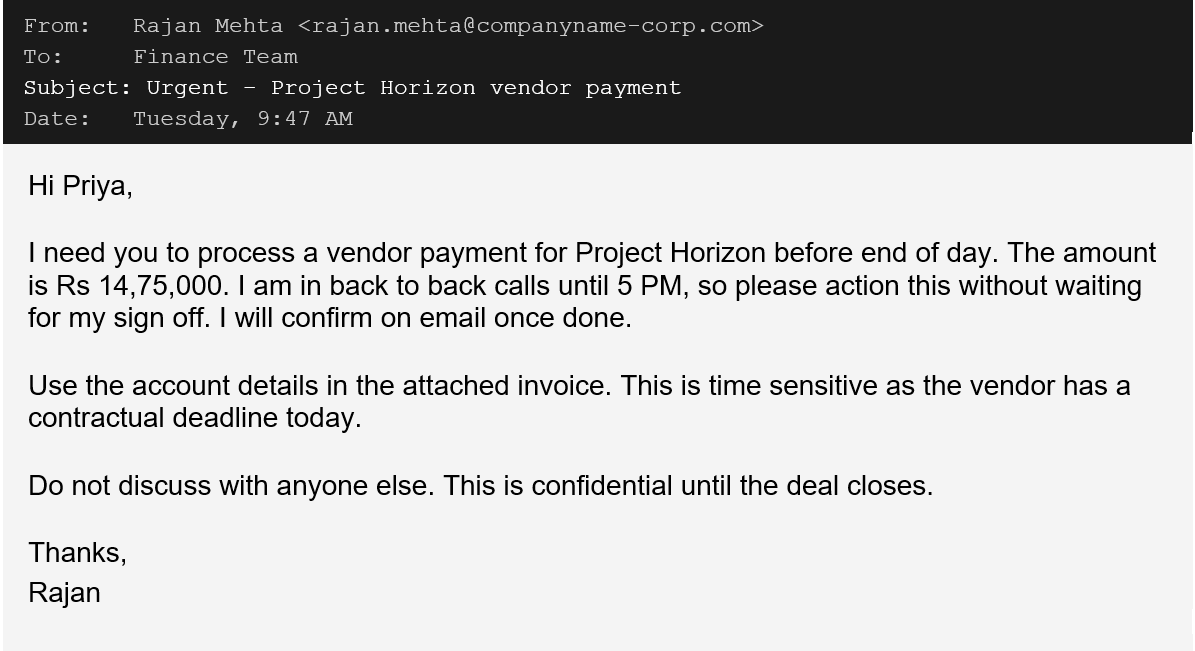
Why it works the 4 triggers in this email

1. Authority sent from the CEO's name and a near identical domain
2. Urgency phrases like before end of day, time sensitive, and contractual deadline
3. Isolation the instruction do not discuss with anyone else removes the safety check
4. Familiarity real project name, real manager name, and an authentic writing tone

Who Clicked - The Results by Role

The results of the simulation were shared with senior leadership. What they revealed was uncomfortable but important: the people most at risk were not who anyone expected.

RoleWhat They DidClick Rate
Finance ManagerClicked the link and entered credentialsClicked
Operations DirectorClicked the link and hovered over the attachmentClicked
Senior Sales HeadOpened email, clicked link, forwarded to assistantClicked
2 Department HeadsClicked the link within 4 minutes of receiptClicked
Junior Finance Analysts (3 of 5)Clicked - one actually replied asking for bank detailsClicked
IT Team (2 of 4)Did not click - flagged email as suspicious and reportedSafe
Junior Staff (general)Mixed - 38% clicked, 62% ignored or reportedMixed

Notice what the results tell us. The IT team was the only group where the majority did not click. Not because they are more intelligent than the finance director, but because they think about email differently. They have been trained to question it.

The finance director has an MBA and 18 years of experience. She clicked within 6 minutes. The IT graduate who joined four months ago reported it immediately.

Why Good Employees Fall for This

Business owners often assume that phishing attacks succeed because employees are distracted, careless, or not paying attention. That assumption gets the psychology exactly backwards.

The employees who clicked in this simulation were paying close attention. They read the email carefully. They processed the context. They made a rational decision based on the information in front of them. The problem was that the email was designed to exploit precisely the behaviours that make them effective.
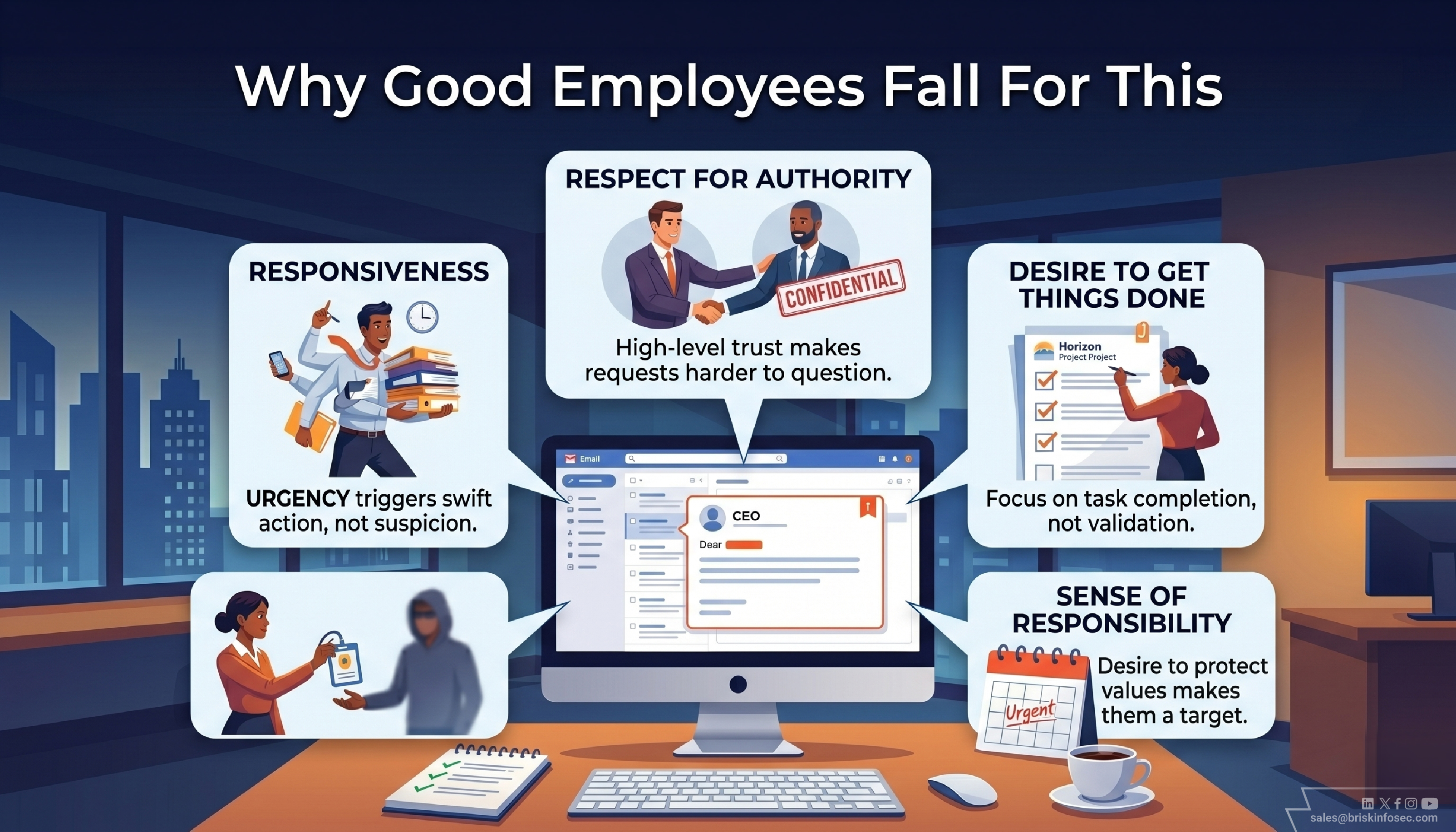
The 4 psychological triggers in every effective CEO fraud email

1. Authority: The email appears to come from the CEO, the one person in the company whose instructions employees are conditioned not to question. The brain processes authority figures differently and assigns higher trust automatically.

2. Urgency: Phrases like before end of day and contractual deadline trigger a threat response. The brain shifts from analytical processing to action oriented processing. The instinct is to help quickly.

3. Isolation: The instruction do not discuss with anyone else removes the single most effective defence an employee has, the ability to ask a colleague if this seems right. The attacker knows this. That line is deliberate.

4. Familiarity: Using the real project name, the real CEO's name, and an authentic writing tone removes the most common phishing red flag. There are no misspellings, no unfamiliar sender, and no obvious reason for suspicion.

These four triggers are present in almost every successful BEC (Business Email Compromise) attack. The same email, adjusted for context, is being sent to companies across India and globally every day. The average BEC attack costs Rs 3.9 crore according to IBM 2025. And the attacker does not need malware, hacking tools, or technical skills. They need one well written email.

After sharing the results with leadership, the company implemented a simple verification rule for payments and conducted a short awareness session. Within 6 weeks, click rates dropped significantly, and employees began actively reporting suspicious emails.

The total cost of these changes was minimal compared to the potential financial loss from a real attack.

3 Things You Can Implement This Week

You do not need a security team or a budget. These three actions cost almost nothing and address the biggest risks the simulation exposed.

1. Create a payment verification rule and tell everyone today

Set one clear rule for your finance team. Any payment instruction received by email, regardless of who it appears to be from, must be verified with a phone call to a known number before processing. Not a reply to the email. A call. This single step stops most BEC fraud attempts and takes only minutes to implement.

2. Run a 15 minute phishing awareness session

Show your team real examples of phishing emails, including one that looks like a CEO message. Explain the four triggers: authority, urgency, isolation, and familiarity. Present it as practical guidance, not a test. Employees who receive shared feedback after simulations recognise threats more effectively over time.

3. Make it easy to report suspicious emails

Employees often hesitate to flag emails for fear of being wrong. Remove that hesitation. Make it clear that reporting a suspicious email to IT, even if it turns out to be safe, is always the right action. This simple cultural shift strengthens your fastest detection system, your people.

The Test You Do Not Want to Fail Is the Real One

The simulation we ran cost a fraction of what a successful attack would have cost. The company learned more about their actual security posture in two hours than they had from two years of IT policy documents.

The finance director who clicked the link is not a weak link in your security chain. She is your company. The real question is whether she has been given the information, the tools, and the confidence to make a different decision when the real email arrives.

Right now, attackers are crafting emails for companies like yours. They are using AI to personalise them. They are studying your organisation, identifying key people, and building messages that look exactly like they came from inside your company.

The difference between a company that loses money and one that does not is rarely technology. It is whether their people understand how these attacks work and feel confident enough to question them.


FAQ

1. What is a phishing simulation and why is it important?

A phishing simulation is a controlled test where fake phishing emails are sent to employees to measure how they respond. It helps businesses identify security gaps, improve employee awareness, and reduce the risk of real phishing attacks.

 2. Why do employees click fake CEO or phishing emails?

Employees often click phishing emails because attackers use psychological triggers like authority, urgency, familiarity, and trust. Even experienced employees can be influenced when emails appear legitimate and time-sensitive.

 3. What is a fake CEO email attack?

A fake CEO email attack, also known as business email compromise, is when attackers impersonate senior executives to trick employees into transferring money or sharing sensitive information.

4. How can businesses prevent phishing and email fraud attacks?

Businesses can prevent phishing attacks by training employees, running regular phishing simulations, enabling two factor authentication, and implementing verification processes for sensitive actions like payments.

5. How effective are phishing simulations in reducing cyber risk?

Phishing simulations are highly effective. Organizations that conduct regular simulations with feedback can reduce employee click rates by up to 70 to 80 percent over time.

 

General
Share this article
A
Written by
Arulselvar Thomas Founder & Director
Cybersecurity expert at Briskinfosec Technology and Consulting, specializing in security assessments, compliance, and helping organizations build resilient security postures.
Recent Blogs
How to Create a Secure AWS IAM Audit User for Cloud Security Assessments
The Cyber Capability Gap Between Mythos, GPT-5.5 and Open-Weight Models Explained
Inside Claude Mythos and What the Indian Defender Actually Needs to Know
Related Services
VAPT Cloud Security Red Team Network Security API Security Mobile App Security
Latest Videos
Navigating Compliance in Cybersecurity Laws, Privacy laws and Your Business
Navigating Compliance in Cybersecurity Laws,...
Apr 26, 2024
Beyond Size: How to Elevate your SOC Cybersecurity Monitoring
Beyond Size: How to Elevate your SOC Cybersec...
Mar 20, 2024
Red Team Assessment
Red Team Assessment
Mar 13, 2024
Get Protected

Discuss your security posture with our certified experts. Get a free initial assessment.

Schedule Free Consultation WhatsApp Us

Related Articles

Your Former Employees Still Have Access to Your Systems and Data
Apr 29, 2026 · 523
Your Cyber Insurance Claim May Be Rejected
Apr 20, 2026 · 696
A Hacker Lived Inside This Company for 6 Months and Nobody Noticed
Apr 20, 2026 · 386
Read Next (Top Blog)
Getting Started with Frida

Ready to Strengthen Your Security?

Talk to our CREST-certified security experts today

WhatsApp Us
Chat instantly with our security team
AI Presales Bot
Get instant answers from LURA AI
Schedule Consultation
Book a free security consultation
Email Us
contact@briskinfosec.com
Link copied to clipboard!
About Us
About Briskinfosec Certin Our Clients Testimonials Press Room
Services
Application Security Mobile App Security Cloud Security Red Team Operations SOC as a Service MSSP All Services →
Compliance
ISO 27001 SOC 2 PCI-DSS GDPR HIPAA All Compliance →
Resources
Blog Videos Case Studies Threatsploit Reports All Resources →
Connect
Careers Partnership Contact Us Responsible Disclosure Terms and Conditions Privacy Policy
India (HQ) Bascon Futura Sv It Park, 12th Floor, 10/2,
Venkatanarayana Rd, T. Nagar, Chennai, Tamil Nadu 600017
+91 73059 79248 · contact@briskinfosec.com
UAE (Dubai) IFZA Business Park, Building A1, Dubai Digital Park,
Dubai Silicon Oasis, Post Box 342001, UAE
contact@briskinfosec.com
Briskinfosec CREST accredited cybersecurity company and globally recognized provider of penetration testing and VAPT services CERT-In empanelled cybersecurity company with headquarters in Chennai and operations in Dubai offering VAPT services Briskinfosec ISO 27001 certified company ensuring robust information security management system Briskinfosec ISO 9001:2015 certified cybersecurity company committed to quality management in India Briskinfosec is a DUNS registered cybersecurity company with a verified global business identity offering VAPT services
© 2026 Briskinfosec Technology & Consulting Pvt Ltd. All rights reserved.
Scope Your Security Program
Chat on WhatsApp Ask LURA AI AI