Cybersecurity has evolved from a technical requirement into a strategic necessity. As organizations adopt cloud first architectures, AI driven applications, remote teams, and third-party integrations, the complexity of defending digital assets has skyrocketed. Yet most enterprises still lack one critical element, a clear, measurable understanding of their cybersecurity maturity.
Many organizations assume they are secure because they have tools, policies, or compliance certifications. But maturity is not about having controls, it is about how well those controls work together. That is where the bSAFE Maturity Score, Briskinfosec’s seven-layer security assessment model, helps organizations gain clarity, alignment, and confidence.
Why Cybersecurity Maturity Matters More Than Ever
Modern cyber threats are faster, more automated, and more coordinated than traditional security models can handle. AI-driven attacks have increased by 300%, and global cybercrime is expected to reach $10.1 trillion by 2025, making it the largest economic threat after natural disasters.
Despite heavy investments in security tools, 62% of organizations overestimate their maturity level. This overconfidence comes from three common issues:
- Tool-Centric Security:
Organizations often equate “tool adoption” with “security maturity,” which creates a false sense of protection. - Siloed Layer Management:
Teams handle data, infrastructure, application, and perimeter security separately, ignoring how these layers depend on each other. - Compliance Over Capability:
ISO, NIST, HIPAA, or PCI DSS compliance ensures structure, not resilience. Attackers don’t follow compliance checklists.
This gap between perceived and actual security is why leaders need a measurable, structured way to evaluate their entire posture end-to-end.
Introducing the bSAFE Maturity Framework
The bSAFE Layered Security Assessment evaluates cybersecurity through seven interconnected layers. This framework is designed to reflect how real-world attacks flow across systems and how defenses must operate holistically.
The 7 Layers of bSAFE:
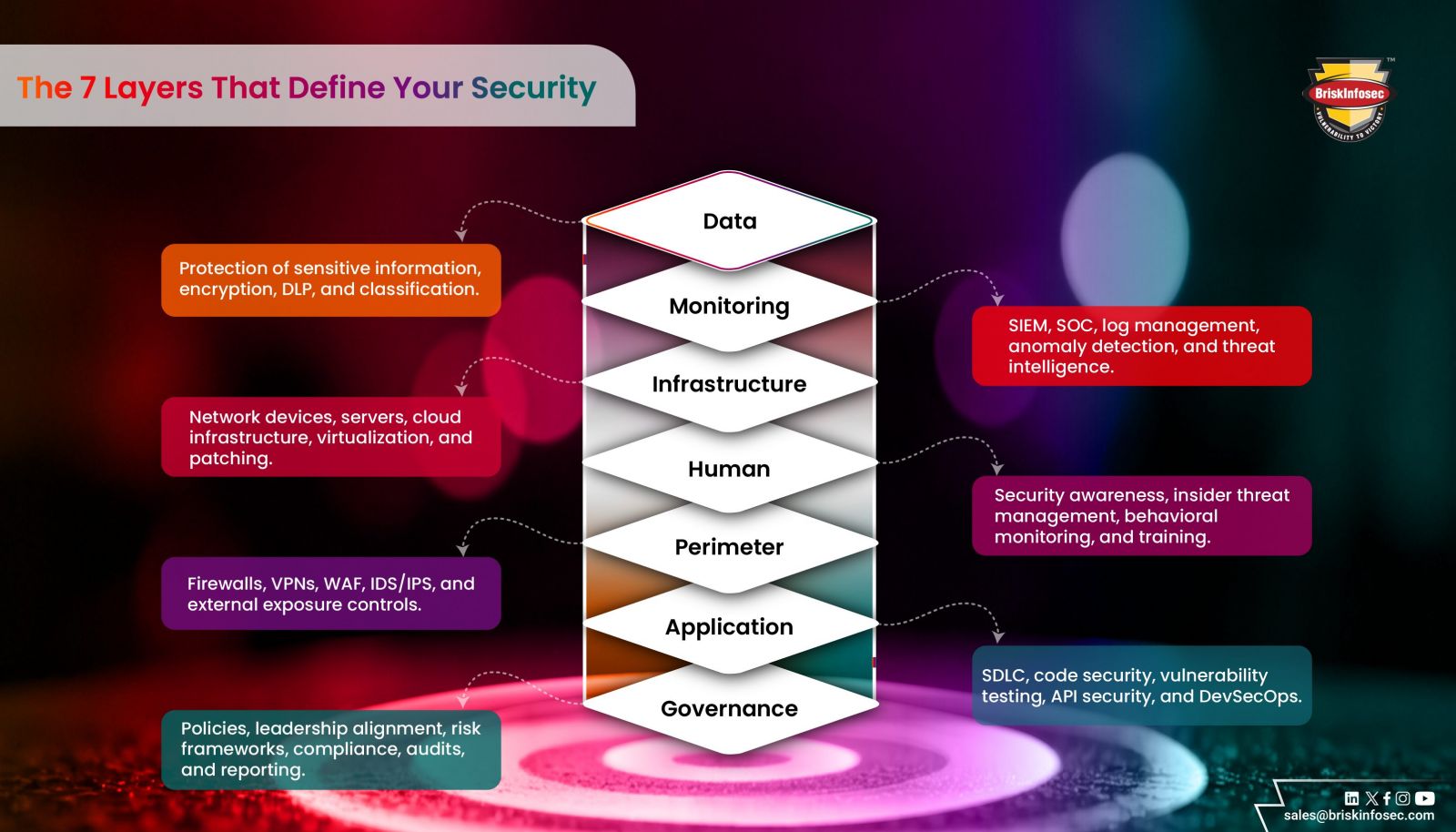
- Data Layer:
Protection of sensitive information, encryption, DLP, and classification. - Monitoring Layer:
SIEM, SOC, log management, anomaly detection, and threat intelligence. - Infrastructure Layer:
Network devices, servers, cloud infrastructure, virtualization, and patching. - Human Layer:
Security awareness, insider threat management, behavioral monitoring, and training. - Perimeter Layer:
Firewalls, VPNs, WAF, IDS/IPS, and external exposure controls. - Application Layer:
SDLC, code security, vulnerability testing, API security, and DevSecOps. - Governance Layer:
Policies, leadership alignment, risk frameworks, compliance, audits, and reporting.
Unlike generic assessments, bSAFE evaluates 73 controls across these seven layers, weighted by your industry and operating model.
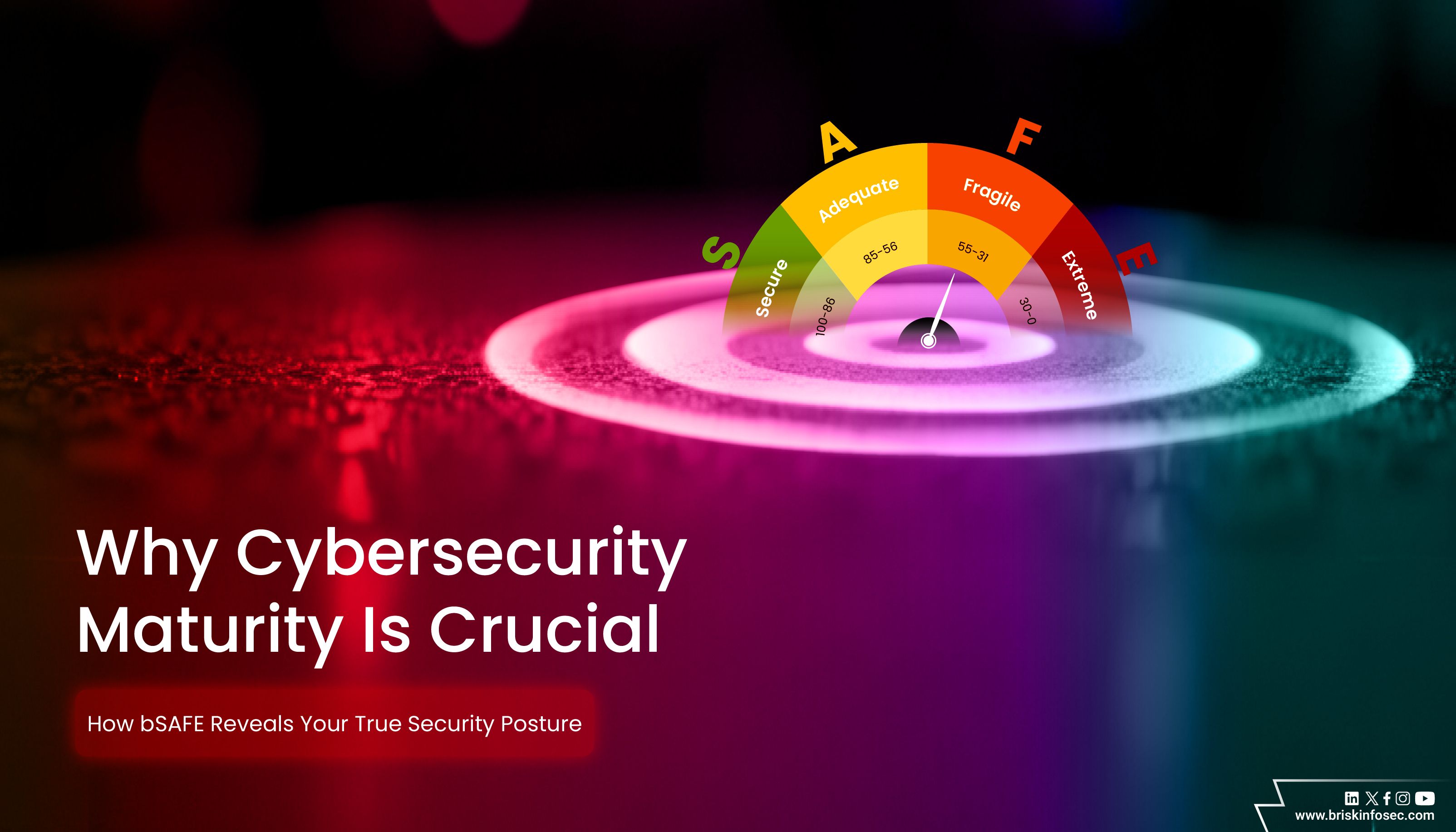
Understanding Your bSAFE Score
The bSAFE Maturity Score classifies organizations into four categories based on responses to 73 control areas mapped to industry standards like NIST, ISO 27001, and sector-specific mandates such as HIPAA or PCI DSS.
|
Score Range |
Category |
Meaning |
|
80% and above |
Secure |
Mature, adaptive, and well-aligned security posture. |
|
60–79% |
Adequate |
Structured and effective but with room for improvement. |
|
40–59% |
Fragile |
Partial implementation with gaps in governance or consistency. |
|
Below 40% |
Extremely Vulnerable |
Reactive, fragmented, and exposed to potential threats. |
Each score delivers targeted insights and actionable recommendations for improvement, helping decision-makers prioritize next steps strategically.
Benefits of Measuring Cybersecurity Maturity with bSAFE
1. Clear Visibility Across All Layers
bSAFE reveals what traditional audits miss, dependency gaps across tools, people, and governance.
2. Prioritized Action Plan
It identifies improvement areas in descending order of risk, helping CISOs invest budgets smartly.
3. Fast, Accurate, and Business Friendly
Unlike lengthy audits, bSAFE offers a quick but strategic understanding for leadership teams.
4. Supports Compliance Frameworks
The model aligns with NIST CSF, ISO 27001, HIPAA, PCI DSS, and BFSI frameworks.
5. Enhances Enterprise Resilience
Organizations using the bSAFE model have achieved up to seventy percent improvement in maturity with structured guidance.
Why Leaders Trust Maturity Scoring Over Traditional Security Reviews
CISOs and CTOs operate under performance pressure, from boards, regulators, and customers. Security decisions must be defendable, measurable, and aligned with business outcomes.
Here’s why maturity scoring has become the preferred leadership tool:
- Board-friendly reporting: Maturity scores are easier to communicate than technical metrics.
- Budget justification: Leaders can show which layers need investment and why.
- Cross-department alignment: Governance, IT, DevOps, and business units gain a unified view.
- Future-readiness: AI-driven attacks target weak integrations; maturity makes these visible.
- Continuous improvement: The score becomes a baseline for tracking annual progress.
Practical Outcomes Delivered by the bSAFE Assessment
Organizations using the bSAFE assessment typically experience improved cyber governance within 30 to 60 days, faster incident response with up to forty percent improvement, and a reduced attack surface by uncovering misaligned security layers. The assessment also helps organizations achieve better SIEM and SOC utilization through stronger monitoring maturity, improved audit readiness with measurable scores, higher employee security awareness, and more consistent patching and monitoring cycles. This is not just an assessment, it is a roadmap.
Conclusion: Know Where You Stand Before Threat Actors Do
Cybersecurity maturity can no longer be assumed; it must be measured, benchmarked, and continuously improved. The bSAFE Maturity Score provides leaders with a clear, objective, and strategic view of their true security posture by highlighting strengths, exposing blind spots, and outlining a practical path to long-term resilience. As threats evolve at unprecedented speed, the organizations that thrive will be those that understand themselves deeply and act with clarity and confidence.
Evaluate Your Cybersecurity Maturity Today
Start with the free bSAFE Maturity Assessment and gain clarity across all seven layers of your security posture.
Discover Your bSAFE Score: https://www.briskinfosec.com/cybersecurityscore
FAQ:
Q1. What is the bSAFE Cybersecurity Maturity Score?
The bSAFE Score is a 7-layer security maturity assessment developed by Briskinfosec to measure how effectively an organization protects data, applications, infrastructure, and governance across 73 controls.
Q2. Why is cybersecurity maturity important in 2025?
With AI-driven attacks rising over 300%, maturity helps organizations understand whether their defenses are aligned, adaptive, and resilient against modern threats.
Q3. How does the bSAFE Assessment work?
The assessment evaluates seven layers including Data, Monitoring, Infrastructure, Human, Perimeter, Application, and Governance, and assigns an overall maturity score ranging from Secure to Extremely Vulnerable.
Q4. Who should take the bSAFE Maturity Assessment?
CISOs, CTOs, IT Managers, Compliance Leaders, and organizations seeking to benchmark or improve their cybersecurity posture should take this assessment.
Q5. What are the benefits of knowing your cybersecurity maturity score?
It helps identify blind spots, prioritize investments, strengthen compliance alignment, improve incident response capacity, and support long-term resilience planning.