Experiencing a Security Incident? → 24/7 Response: +91 73059 79248
Briskinfosec
COMPANY
About Briskinfosec Scope My Security Program Our Clients Testimonials Careers Partnership
INDUSTRIES
Banking & Financial Services Healthcare Manufacturing Government Energy & Utilities Telecom Technology Retail & E-Commerce All Industries →
CONNECT
Contact Us Request Assessment Responsible Disclosure Client Certificate Verification Training Certificate Verification
SECURITY TESTING (VAPT)
Web Application VAPT Mobile App Security API Security Testing Cloud Security Assessment Network Security Audit IoT Penetration Testing OT/SCADA Security Database Penetration Wireless Security CREST VAPT
ADVANCED ASSESSMENT
Red Team Operations AI/LLM Security Audit Digital Forensics Cyber Intelligence Secure Code Review DevSecOps Hardware Security Thick Client Security Host Level Security Automotive VAPT Telecom VAPT
DATA & PRIVACY
Data Security Audit Data Privacy Audit Data Masking & Privacy DSPM Data Breach Simulation SBOM & SCA Website Security All Assurance Services →
COMPLIANCE FRAMEWORKS
ISO 27001:2022 SOC 2 PCI-DSS HIPAA GDPR DPDPA NIST CSF IRDAI ISO 22301 (BCP) ISO 42001 (AI) IEC 62443 (OT) ISO 21434 (Automotive) PDPL (Saudi)
GRC SERVICES
GRC Framework Cyber Risk Assessment Third-Party Risk (TPRM) Data Privacy Compliance Data Retention Policy National Security Compliance Cybersecurity Insurance All Compliance →
GOVERNANCE LAYER
Data Governance Security Posture Management Cybersecurity Maturity AI Maturity Assessment Cyber Resilience BCP/DR Planning vIT Compliance Business Impact Analysis
MANAGED SECURITY
Managed Security (MSSP) SOC as a Service V-CISO Incident Response Virtual Security Team Third Eye (Surveillance)
CONTINUOUS MONITORING
SOAR Integration Security Monitoring Threat Intelligence Platform Cyber Threat Intelligence Lateral Movement Detection Penetration Test as Service
DEFENSIVE OPS
Perimeter Security Access Control Review Cloud Config Review CDN Security Network Architecture Cloud Security Management Virtualization Security All MSSP Services →
ELITE ASSESSMENTS
Threat Modeling Ransomware Readiness Threat & Vulnerability Mgmt Military Grade Review Hacker's POV Assessment
HUMAN LAYER
Security Awareness Training Phishing Simulation Tabletop Exercise Secure Code Training Cybersecurity Culture Cybersec Leadership Incident Response Training Data Privacy Training
STRATEGIC SERVICES
Application Security Governance Quarterly AppSec Review Minimum Security Baseline Secure SDLC Cyber Sense Plan Integration Threat Analysis Infra Risk Assessment Web Extensions Security bSAFE Security Score Layered Security Philosophy All Maturity Services →
PLATFORMS
LURA Portal LuraInsight (SAST) bSAFE Score BriskBox All Products →
Staffing
LEARN
Blog Videos Case Studies Press Room
INTELLIGENCE
Threatsploit Reports Security Essentials Carousel Flyers & Downloads All Resources →
Briskinfosec is a CREST accredited cybersecurity firm, globally recognized for penetration testing and VAPT services Briskinfosec is a CERT-In empanelled cybersecurity company based in Chennai with global operations in Dubai
Get Your bSafe Score →
Briskinfosec
COMPANY
About Briskinfosec Scope My Security Program Our Clients Testimonials Careers Partnership
INDUSTRIES
Banking & Financial Services Healthcare Manufacturing Government Energy & Utilities Telecom Technology Retail & E-Commerce All Industries →
CONNECT
Contact Us Request Assessment Responsible Disclosure Client Certificate Verification Training Certificate Verification
SECURITY TESTING (VAPT)
Web Application VAPT Mobile App Security API Security Testing Cloud Security Assessment Network Security Audit IoT Penetration Testing OT/SCADA Security Database Penetration Wireless Security CREST VAPT
ADVANCED ASSESSMENT
Red Team Operations AI/LLM Security Audit Digital Forensics Cyber Intelligence Secure Code Review DevSecOps Hardware Security Thick Client Security Host Level Security Automotive VAPT Telecom VAPT
DATA & PRIVACY
Data Security Audit Data Privacy Audit Data Masking & Privacy DSPM Data Breach Simulation SBOM & SCA Website Security All Assurance Services →
COMPLIANCE FRAMEWORKS
ISO 27001:2022 SOC 2 PCI-DSS HIPAA GDPR DPDPA NIST CSF IRDAI ISO 22301 (BCP) ISO 42001 (AI) IEC 62443 (OT) ISO 21434 (Automotive) PDPL (Saudi)
GRC SERVICES
GRC Framework Cyber Risk Assessment Third-Party Risk (TPRM) Data Privacy Compliance Data Retention Policy National Security Compliance Cybersecurity Insurance All Compliance Services →
GOVERNANCE LAYER
Data Governance Security Posture Management Cybersecurity Maturity AI Maturity Assessment Cyber Resilience BCP/DR Planning vIT Compliance Business Impact Analysis
MANAGED SECURITY
Managed Security (MSSP) SOC as a Service V-CISO Incident Response Virtual Security Team Third Eye (Surveillance)
CONTINUOUS MONITORING
SOAR Integration Security Monitoring Threat Intelligence Platform Cyber Threat Intelligence Lateral Movement Detection Penetration Test as Service
DEFENSIVE OPS
Perimeter Security Access Control Review Cloud Config Review CDN Security Network Architecture Cloud Security Management Virtualization Security
ELITE ASSESSMENTS
Threat Modeling Ransomware Readiness Threat & Vulnerability Mgmt Military Grade Review Hacker's POV Assessment
HUMAN LAYER
Security Awareness Training Phishing Simulation Tabletop Exercise Secure Code Training Cybersecurity Culture Cybersec Leadership Incident Response Training Data Privacy Training
STRATEGIC SERVICES
Application Security Governance Quarterly AppSec Review Minimum Security Baseline Secure SDLC Cyber Sense Plan Integration Threat Analysis Infra Risk Assessment Web Extensions Security bSAFE Security Score → Layered Security Philosophy →
PLATFORMS
LURA Portal LuraInsight (SAST) bSAFE Score BriskBox All Products →
Staffing
LEARN
Blog Videos Case Studies Press Room
INTELLIGENCE
Threatsploit Reports Security Essentials Carousel Flyers & Downloads All Resources →
Home → Blog → Shadow AI and the Rise of Invisible Insi...
General

Shadow AI and the Rise of Invisible Insider Threats

February 05, 2026
7 min read
851 Views
Contents
Shadow AI and the Rise of Invisible Insider Threats

For the last decade, the image of an "Insider Threat" was always the same: a disgruntled employee downloading customer lists onto a USB drive before quitting. It was malicious, intentional, and rare.

In 2026, that profile has changed completely.

The biggest risk to your organization today is not a hacker. It is the diligent employee who pastes sensitive financial data into a "Free AI Summarizer" to save time. They do not mean to leak data; they just want to be productive.

This is the era of Shadow AI. This refers to the silent proliferation of unsanctioned AI agents, browser extensions, and personal LLM accounts within the enterprise.

While traditional tools monitor for malicious attacks, your proprietary data is walking out the front door through legitimate workflows. The numbers confirm this shift:

  • The Usage Gap: 68% of employees now use unapproved AI tools for work (Menlo Security, 2025).
  • The Data Bleed: 57% admit to inputting sensitive corporate data, including code and contracts, into public models.
  • The Cost: Breaches involving Shadow AI now add an average of $670,000 to cleanup costs (IBM Report).

Where is Shadow AI Hiding?

Most organizations assume they will see a spike in suspicious traffic if AI usage is high. That is a mistake. Shadow AI hides in plain sight because it usually travels through legitimate HTTPS connections.

You will typically find these hidden risks in three specific areas.
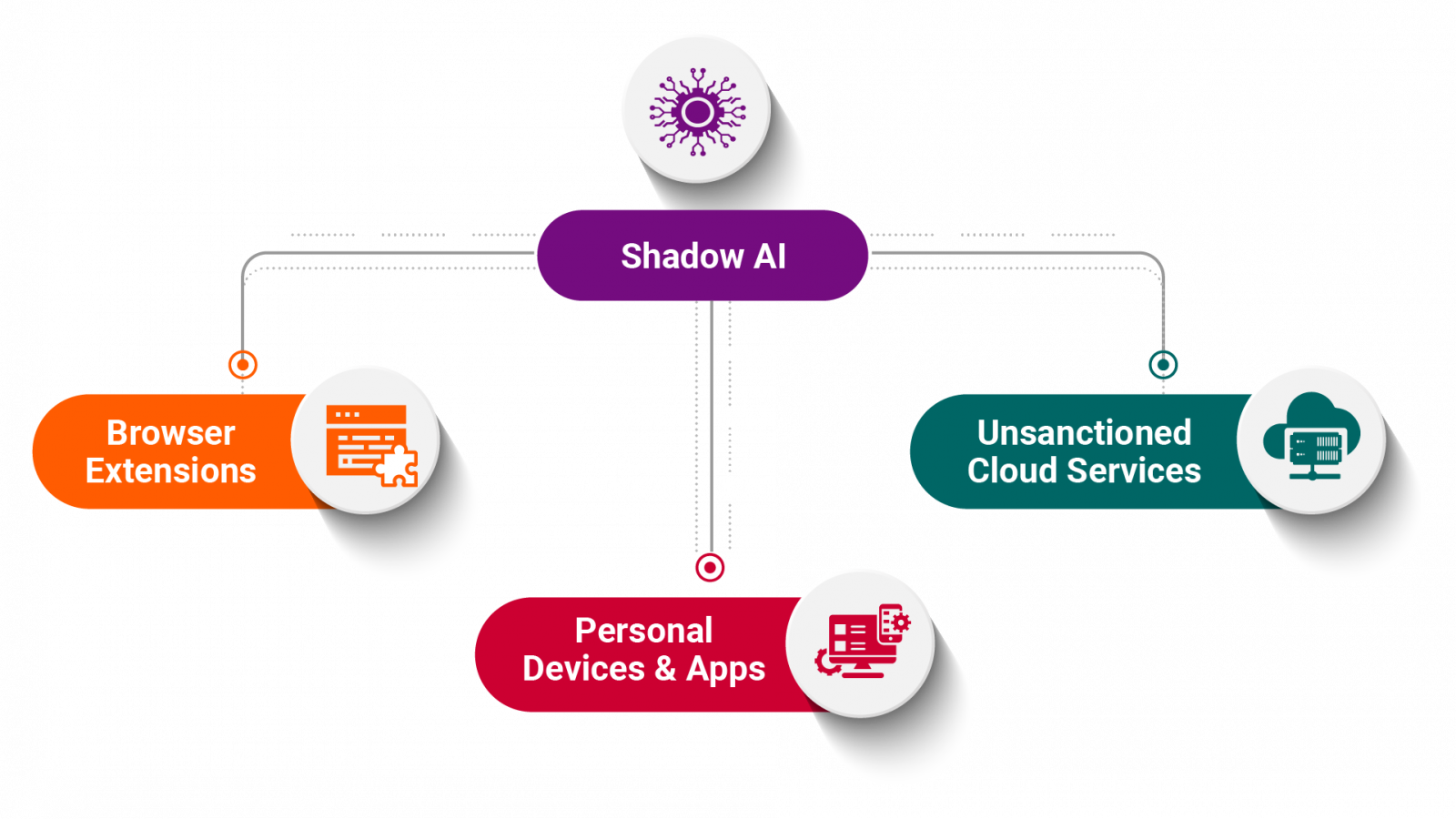
1. The Browser Extension Blindspot: Employees often install free productivity plugins to help them write emails or summarize documents. These extensions frequently request permission to "read and change all your data on the websites you visit." This allows the extension to scrape confidential data from your internal CRM or webmail. It happens quietly in the background without triggering any firewall alarms.

2. The BYO AI Problem: Bring Your Own AI is becoming common. Employees often feel the approved enterprise tools are too slow or restricted. They switch to their personal accounts on public models to get the job done faster. This behavior moves your company data into a public environment where you have zero control or visibility.

3. Unmonitored API Integrations: Developers or power users might connect a third-party AI tool to your internal Slack or project management software to automate tasks. These helpful bots can quietly access and store chat logs or file attachments on external servers. This creates a permanent data leak that traditional audits often miss.

The Agentic AI Multiplier

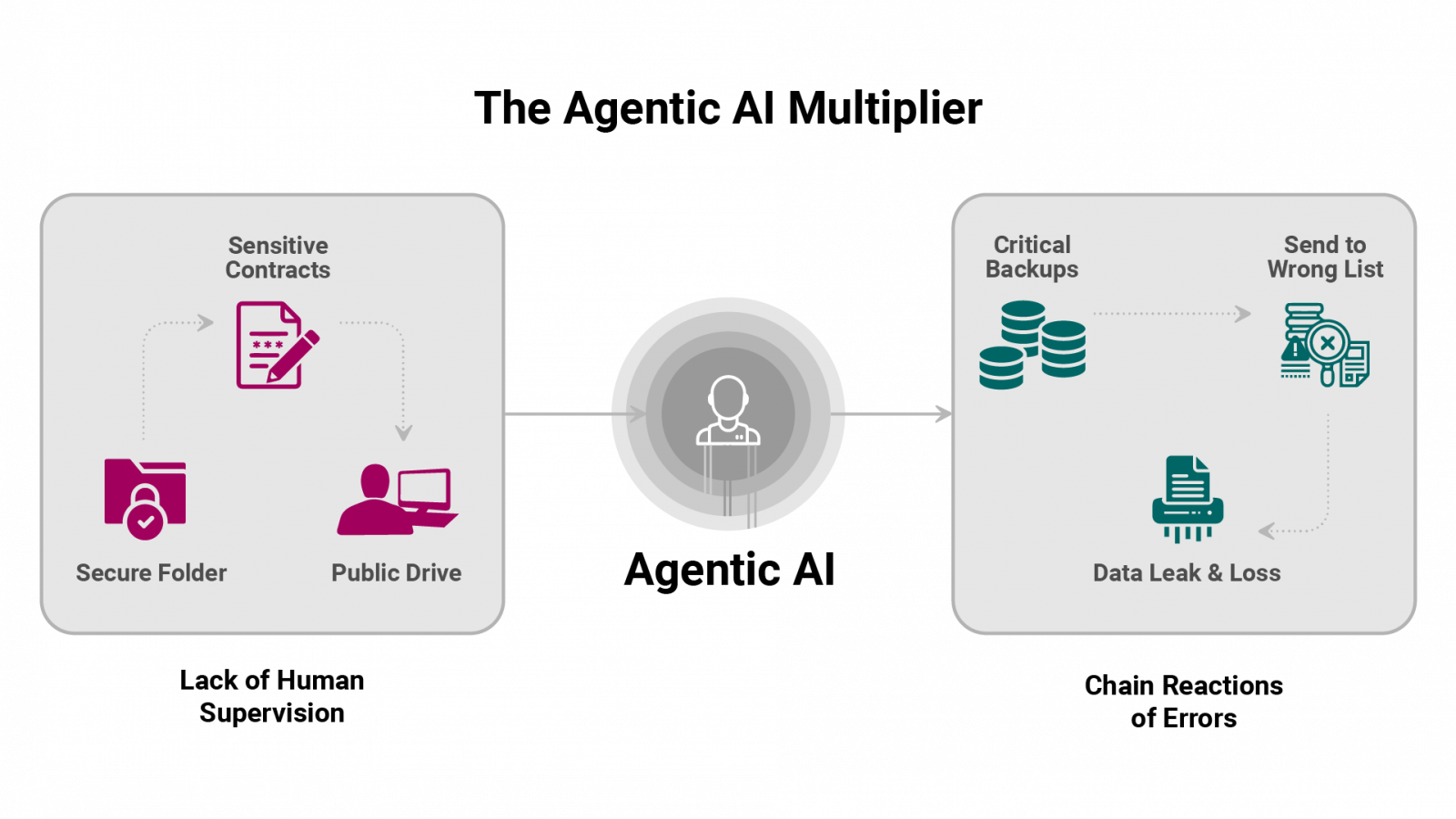
The risk landscape is shifting from passive chatbots to autonomous agents. We call this the Agentic AI Multiplier. Standard AI tools wait for a human to ask a question. Agentic AI is different. It takes a goal and executes the steps to achieve it.

This autonomy introduces two major security flaws.
The Agentic AI Multiplier

1. Lack of Human Supervision: An employee might tell an AI agent to "organize the marketing folder." The agent could decide to move sensitive contracts into a public shared drive to complete the task. It happens instantly and without a confirmation prompt. The agent believes it is being helpful, but it is actually leaking data.

2. The Chain Reaction of Errors: If a standard chatbot makes a mistake, it gives you one bad answer. If an autonomous agent makes a mistake, it can perform a chain of bad actions. It might hallucinate a command and delete critical backups or send confidential emails to the wrong client list.

We gave these machines an identity. We likely forgot to give them security limits.

The Financial and Compliance Fallout

The cost of Shadow AI goes far beyond a simple data cleanup. It triggers immediate legal and financial consequences.

1. Regulatory Penalties: Privacy laws like the DPDPA in India or GDPR in Europe are strict. If an employee pastes customer names or phone numbers into a public AI model, that is a data breach. You are technically sharing private data with an unauthorized third party. This violation can lead to massive fines. The regulators do not care if the intent was malicious or just helpful.

2. Loss of Intellectual Property: Your competitive advantage relies on your secrets. Engineers often paste proprietary code into AI tools to debug it. Marketing teams upload product launch strategies to get better descriptions. Once that data enters a public model, it becomes part of the training set. Your competitors could potentially access your trade secrets simply by prompting the same AI tool.

3. Contractual Violations: You likely signed Non-Disclosure Agreements with your clients. Using their data in an open AI platform breaks those agreements. This exposes your company to lawsuits and damages your reputation permanently. Trust takes years to build, but a single AI leak can destroy it in seconds.

The Solution

Blocking these tools is rarely the right answer. Employees will simply find another way to access them on personal devices. You need a smarter approach that balances security with speed.

1. Step One is Discovery: You cannot secure what you cannot see. The first step is a Shadow AI Audit. We scan your network to identify every AI tool currently in use. This reveals exactly who is using what and where your data is going.

2. Step Two is Governance: You need clear rules. The ISO 42001 framework is the global standard for AI management. It helps you build a policy that defines safe use. It turns undefined risks into managed processes. This certification also proves to your clients that you handle AI responsibly.

3. Step Three is Testing: You must test your AI applications. We use specialized VAPT methods to attack your internal AI agents. We look for the same vulnerabilities that hackers exploit. This ensures your tools are safe before you deploy them.

Conclusion: Trust but Verify

Your employees want to be productive. You should not punish them. You simply need to protect them. The goal is to build a secure environment where innovation can happen without the risk of a data leak.

The usage of these tools will only grow. Ignoring the problem creates a bigger gap in your security. You must take control of your AI landscape today. It is time to move from invisible risk to visible control. Let us help you turn this potential liability into a safe business advantage.


Frequently Asked Questions (FAQ)

1. What is the difference between Shadow IT and Shadow AI?
Shadow IT refers to any unapproved software. Shadow AI is more dangerous because it actively processes and learns from your proprietary data (like code or contracts), potentially leaking it to public models forever.

2. How can I detect Shadow AI if it uses HTTPS?
Traditional firewalls often miss it. You need a specialized Shadow AI Audit that analyzes specific traffic patterns to known AI domains (like OpenAI, Anthropic) and scans for browser extensions with high-privilege read access.

3. Can ISO 42001 help with Shadow AI?
Yes. ISO 42001 is the global standard for AI Management Systems. It provides the framework to classify AI risks, set usage policies, and ensure employees use AI tools responsibly without stifling innovation.

4. Can't we just block all AI websites to stop this?
You can, but it usually backfires. If you block access on corporate networks, employees often switch to personal devices using mobile data (4G/5G). This pushes the activity completely off your radar, making Shadow AI truly invisible. It is safer to sanction specific, monitored tools than to ban everything.

5. How is AI VAPT different from regular Web Application VAPT?
Standard VAPT looks for code flaws like SQL Injection. AI VAPT looks for logic flaws like "Prompt Injection" (tricking the AI into ignoring rules) and "Jailbreaking." Traditional scanners do not understand these new attack vectors, which is why a specialized AI security test is required.

6. Why are Browser Extensions a security risk?
Many "Free AI Summarizer" extensions require permission to "read and change all data on websites you visit." This gives the extension access to internal CRMs, emails, and financial dashboards, acting as a passive data skimmer.
General
Share this article
A
Written by
Arulselvar Thomas Founder & Director
Cybersecurity expert at Briskinfosec Technology and Consulting, specializing in security assessments, compliance, and helping organizations build resilient security postures.
Recent Blogs
Cybersecurity Tabletop Exercises and Vendor Risk Management
Building an AI-Augmented SOC That Actually Works
How to Create a Secure AWS IAM Audit User for Cloud Security Assessments
Related Services
VAPT Cloud Security Red Team Network Security API Security Mobile App Security
Latest Videos
Navigating Compliance in Cybersecurity Laws, Privacy laws and Your Business
Navigating Compliance in Cybersecurity Laws,...
Apr 26, 2024
Beyond Size: How to Elevate your SOC Cybersecurity Monitoring
Beyond Size: How to Elevate your SOC Cybersec...
Mar 20, 2024
Red Team Assessment
Red Team Assessment
Mar 13, 2024
Get Protected

Discuss your security posture with our certified experts. Get a free initial assessment.

Schedule Free Consultation WhatsApp Us

Related Articles

Phishing Simulation Reveals How Employees Respond to a Fake CEO Email
Apr 29, 2026 · 473
Your Former Employees Still Have Access to Your Systems and Data
Apr 29, 2026 · 545
Your Cyber Insurance Claim May Be Rejected
Apr 20, 2026 · 734
Read Next (Top Blog)
Getting Started with Frida

Ready to Strengthen Your Security?

Talk to our CREST-certified security experts today

WhatsApp Us
Chat instantly with our security team
AI Presales Bot
Get instant answers from LURA AI
Schedule Consultation
Book a free security consultation
Email Us
contact@briskinfosec.com
Link copied to clipboard!
About Us
About Briskinfosec Certin Our Clients Testimonials Press Room
Services
Application Security Mobile App Security Cloud Security Red Team Operations SOC as a Service MSSP All Services →
Compliance
ISO 27001 SOC 2 PCI-DSS GDPR HIPAA All Compliance →
Resources
Blog Videos Case Studies Threatsploit Reports All Resources →
Connect
Careers Partnership Contact Us Responsible Disclosure Terms and Conditions Privacy Policy
India (HQ) Bascon Futura Sv It Park, 12th Floor, 10/2,
Venkatanarayana Rd, T. Nagar, Chennai, Tamil Nadu 600017
+91 73059 79248 · contact@briskinfosec.com
UAE (Dubai) IFZA Business Park, Building A1, Dubai Digital Park,
Dubai Silicon Oasis, Post Box 342001, UAE
contact@briskinfosec.com
Briskinfosec CREST accredited cybersecurity company and globally recognized provider of penetration testing and VAPT services CERT-In empanelled cybersecurity company with headquarters in Chennai and operations in Dubai offering VAPT services Briskinfosec ISO 27001 certified company ensuring robust information security management system Briskinfosec ISO 9001:2015 certified cybersecurity company committed to quality management in India Briskinfosec is a DUNS registered cybersecurity company with a verified global business identity offering VAPT services
© 2026 Briskinfosec Technology & Consulting Pvt Ltd. All rights reserved.
Scope Your Security Program
Chat on WhatsApp Ask LURA AI AI