Every CISO this year has been pitched an AI-powered Security Operations Centre. The vendor demonstrations are polished, the promises are compelling, and the operational reality is considerably more nuanced. Some AI-augmented SOC patterns genuinely improve detection and response velocity. Others are expensive overlays on tooling organisations already own.
This article is based on Briskinfosec's operational experience running bSOC, our AI-augmented managed SOC service, across approximately thirty Indian and international enterprise clients. Every pattern described here comes from what has worked in production environments, not from vendor reference architectures.
Why the AI-SOC Conversation Is Different This Time
Security operations teams have absorbed waves of automation promises before. SOAR in 2017, UEBA in 2019, and XDR consolidation in 2021 each delivered partial wins alongside significant integration debt. AI-SOC claims deserve the same scrutiny, yet the underlying capability shift this time is genuine.
Large language models and advanced machine learning detection pipelines now operate at a qualitatively different level than rule-based automation. The critical difference is not speed alone. It is the ability to contextualise ambiguous signals by reading a sequence of events across disparate log sources and generating a coherent attack hypothesis in seconds, rather than requiring an analyst to manually correlate the same data over hours.
The Indian regulatory environment adds further urgency. CERT-In's CIAD-2026-0020 advisory mandates continuous threat-intelligence-driven monitoring with a 24-hour patch SLA on critical findings. Meeting that SLA consistently at enterprise log volumes requires machine-assisted triage. A SOC operating on purely human tempo cannot reliably achieve it at scale.
What AI in the SOC Changes and What It Does Not
Three Areas Where AI Delivers Genuine Improvement
- Triage speed at volume: AI reads, correlates, and contextualises alerts faster than any human team, eliminating alert fatigue, which is the most common failure mode of traditional SOCs.
- Attack hypothesis generation: AI proposes plausible attack narratives for ambiguous signals, accelerating the analyst's investigative process from minutes to seconds.
- Telemetry coverage at scale: AI surfaces weak signals such as low-and-slow exfiltration patterns, dormant command-and-control beacon traffic, and credential-access precursors that conventional signature-based rules would never detect.
Areas Where Human Judgement Remains Non-Negotiable
- Final response decisions must be made by a human analyst with full situational awareness.
- Critical incident communications, including breach notifications and executive updates, require human authorship and accountability.
- Forensic chain-of-custody integrity depends on human oversight to remain legally defensible.
- Strategic threat modelling requires human understanding of business context that AI cannot replicate.
Any vendor positioning an autonomous SOC that removes humans from the decision loop is either misrepresenting the technology or under-pricing the liability exposure the organisation would be absorbing.
The Four-Layer Architecture That Works in Practice
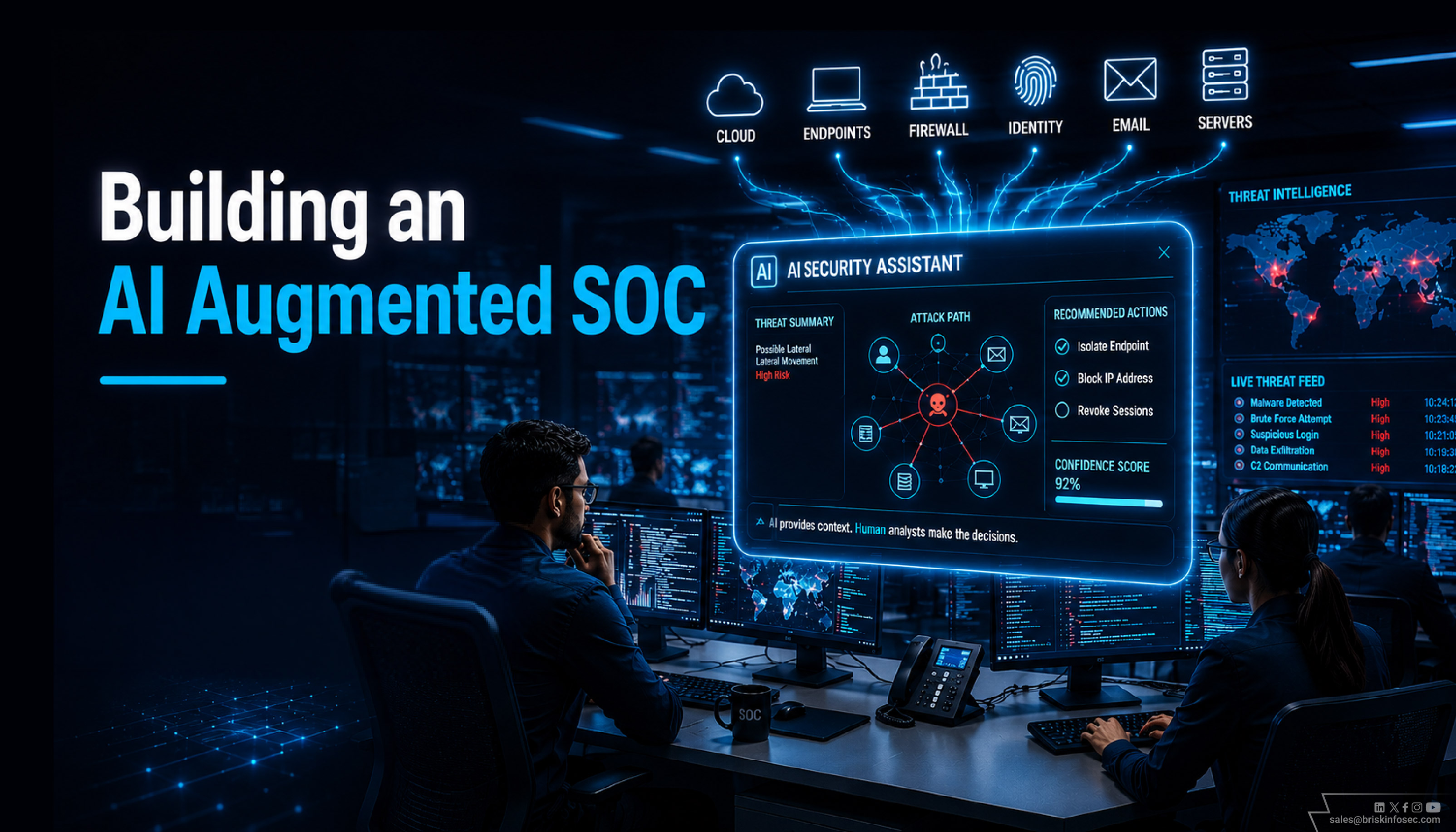
Effective AI-SOC deployments share a consistent structural pattern regardless of tooling vendor. The architecture divides responsibility across four layers, each with a distinct function and a defined boundary between machine-assisted and human-led activity.
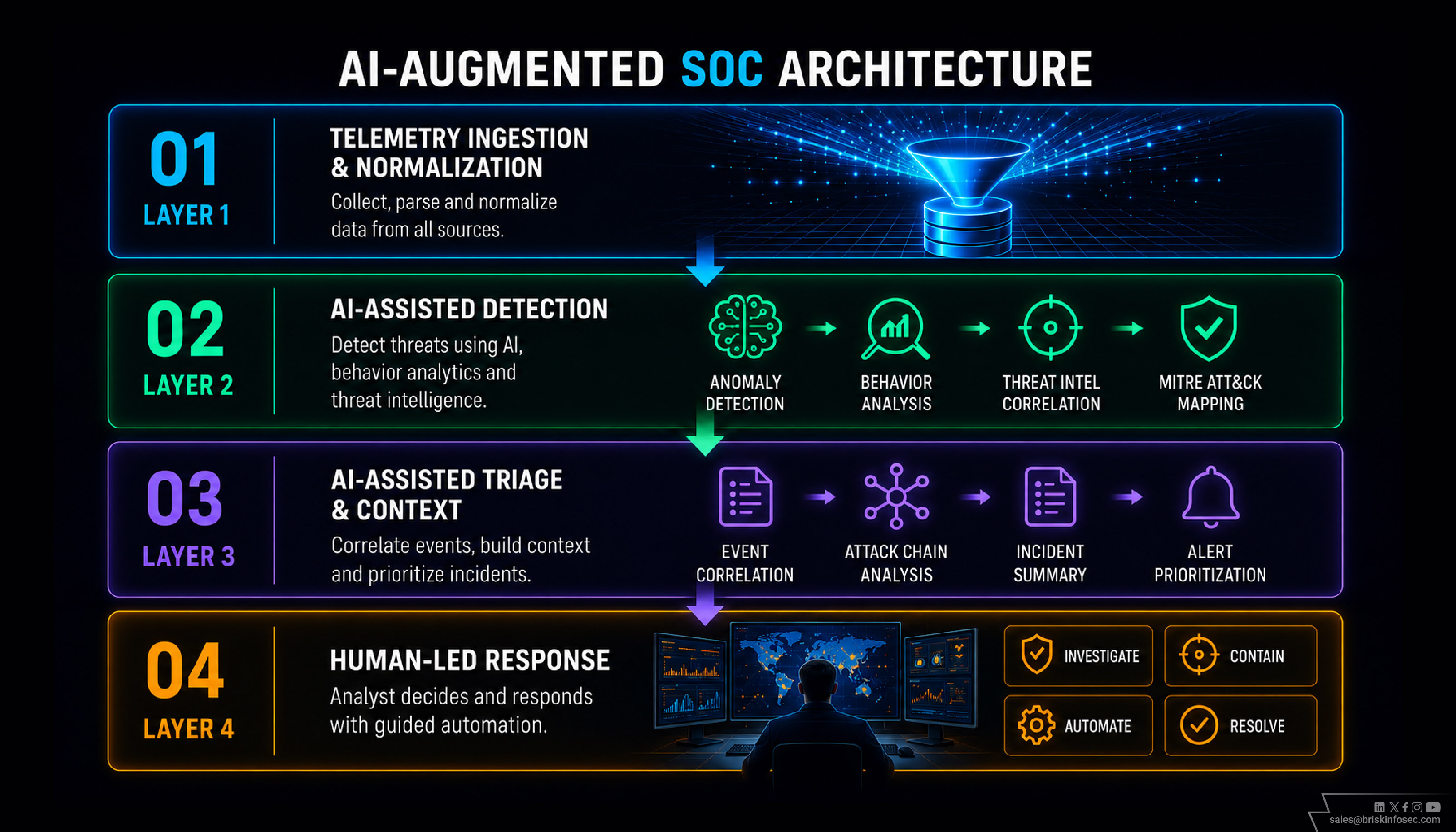
Layer 1: Telemetry Ingestion and Normalisation. AI is not the differentiator at this layer. Broad log source coverage, consistent data schemas, and reliable pipeline health are. Weak telemetry at Layer 1 propagates as unreliable detections at Layer 2. The data engineering work cannot be deferred in favour of rushing to AI capabilities.
Layer 2: AI-Assisted Detection. This layer covers anomaly detection, behavioural baselining, MITRE ATT&CK-aligned pattern matching, and threat intelligence correlation. The AI detection layer sits alongside the existing SIEM rule library rather than replacing it. Rule-based detections remain valuable for known attack patterns while machine learning models handle the ambiguous residual signals.
Layer 3: AI-Assisted Triage and Contextualisation. When an alert fires, an LLM-driven workflow automatically assembles the relevant context: asset criticality rating, recent change events, threat intelligence relevance, and similar historical incidents. The analyst opens the case with that context already on screen rather than starting from a raw alert ID with no background.
Layer 4: Human-Led Response. The analyst makes the final decision. AI tooling executes lower-risk actions under playbook authorisation, such as blocking IP addresses, isolating endpoints, and revoking active sessions. Higher-risk containment and remediation actions remain human-confirmed. The boundary between automated and human-confirmed actions is explicit and enforced.
Three Deployment Patterns That Consistently Fail
- Replacing analysts entirely: Aggressive autonomous-SOC pitches model headcount reduction as the primary ROI driver. In practice, they eliminate human judgement and reintroduce the detection errors that humans exist to catch, typically within the first quarter of production operation.
- Ignoring data hygiene: AI tooling deployed on top of inconsistent log schemas produces inconsistent detection results. The data engineering prerequisite is non-negotiable. Poor input produces poor output regardless of how sophisticated the AI layer is.
- Treating AI-SOC as a product purchase rather than a service model: A capable SOC is a function of people, process, and tooling working in coordination. Purchasing the technology layer without establishing the operating model produces dashboards, not defence.
Real-World Outcome: Fintech AI-SOC Migration
CASE STUDY | Financial Services Sector, India
Before the transition: The SOC team processed approximately 200 alerts per analyst per shift. Real incidents were being systematically buried under the volume of noise. Mean-time-to-detect on credential-stuffing campaigns, which are a high-frequency attack vector in Indian fintech, stood at 46 hours. Analyst attrition was accelerating as the team found the work unrewarding.
After six months on a co-managed AI-SOC retainer: Mean-time-to-detect dropped to 7 hours. Analyst headcount did not change. The AI triage layer eliminated the noise-sorting burden so that analysts were investigating genuine incidents rather than triaging probable false positives. Team attrition stopped.
Board-Level Metrics: Benchmarks After AI-SOC Deployment
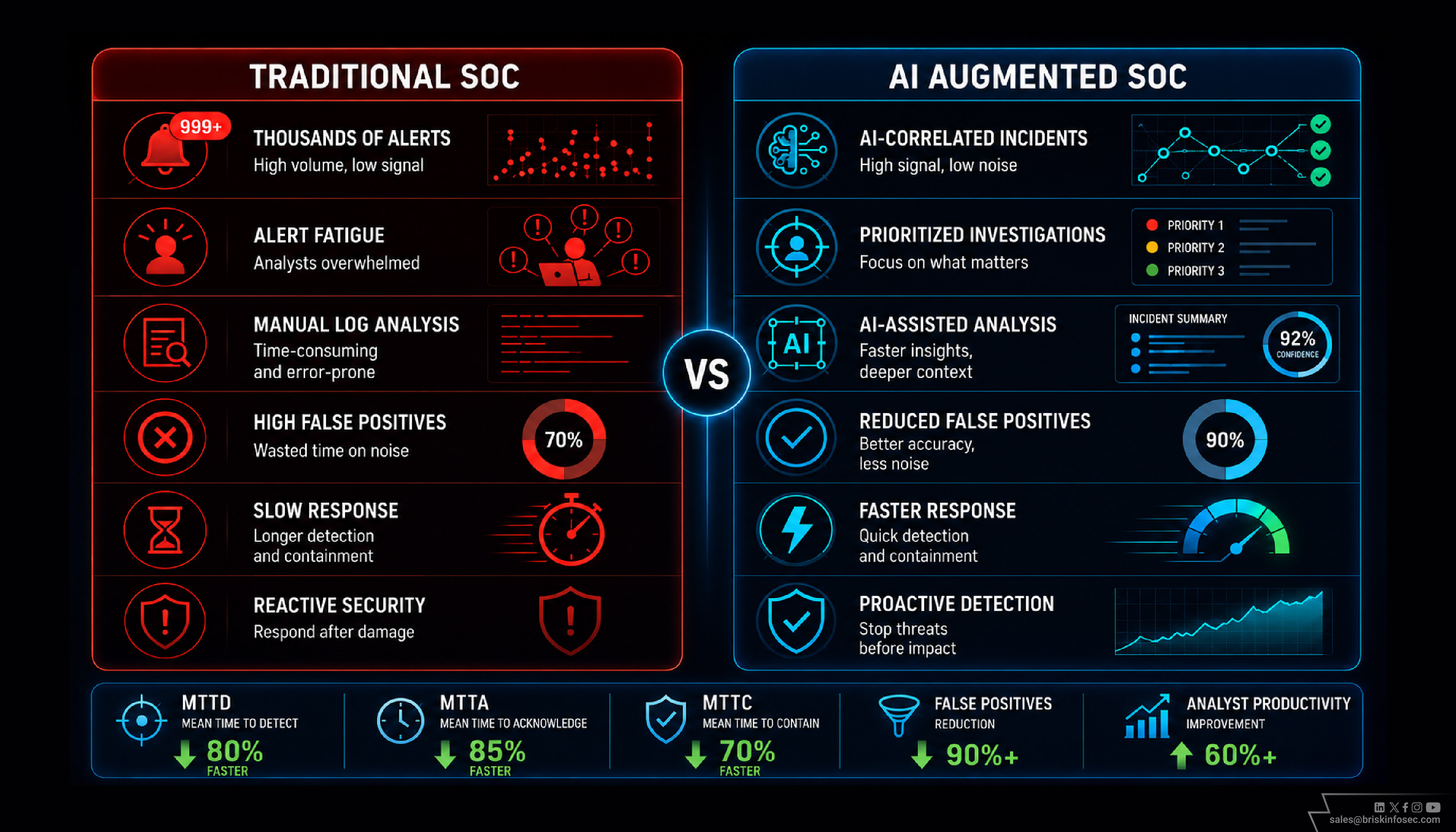
The following benchmarks reflect healthy post-deployment performance observed across managed AI-SOC engagements. Track these metrics from the first week of production operation to establish the improvement trajectory.
| Metric | Definition | Target After AI-SOC |
| MTTD | Time from compromise to first alert | Under 4 hours for critical severity |
| MTTA | Time from alert to analyst review | Under 10 minutes for critical severity |
| MTTC | Time from alert to active containment | Under 6 hours for critical severity |
| False-Positive Rate | Triaged alerts confirmed as noise | Below 30% on tuned detection content |
Business Impact and the ROI Case
Operational efficiency gains materialise within the first three months. These include reduced analyst overtime, lower alert triage burden, and significantly less time spent investigating false positives. These gains appear directly on the cost side of the P&L in the short term.
Risk reduction value is harder to quantify precisely but is material. A 39-hour reduction in mean-time-to-detect represents a substantially smaller breach window and directly supports compliance with CERT-In SLA obligations. The financial exposure of a breach that runs for 46 hours versus 7 hours is not marginal.
Talent retention is the most frequently overlooked business case. Analyst attrition in Indian SOC environments is structurally high, driven by alert fatigue and a lack of meaningful analytical work. AI-augmented SOCs that eliminate noise-sorting improve analyst job satisfaction and reduce turnover. The full replacement cost of a trained SOC analyst, including recruitment, onboarding, and ramp-up time, is routinely underestimated in ROI models.
Most organisations see measurable operational efficiency gains within three months of deployment. Risk-adjusted return on investment is typically positive by month six, based on delivery data across managed AI-SOC engagements.
Conclusion
AI-SOC is real, operationally mature, and demonstrably beneficial when integrated with the right architecture and operating model. The four-layer approach works. The metrics are measurable from day one. The return on investment case is positive within six months.
What does not work is the autonomous-SOC model that removes human judgement from the decision loop, reduces headcount on day one, and calls it a security programme. The goal of AI in the SOC is not to replace analysts. It is to give them back the time and cognitive capacity to do the work that only humans can do: investigate, decide, and defend.
Build the architecture correctly, instrument the metrics from the start, maintain the human decision boundary, and the AI-augmented SOC will deliver on its promise.
Frequently Asked Questions
1. Do we need to replace our SIEM to adopt an AI-SOC architecture?
No. The most effective AI-SOC architectures are additive. They sit alongside the existing SIEM and extend detection and triage capability without requiring a migration. The current rule library and tuned detection content remains operational. The AI layer augments what is already in place.
2. Can a mid-market or small enterprise afford AI-SOC services?
Increasingly, yes. Co-managed and fully managed AI-SOC offerings have priced down considerably over the past two years. A minimum viable service covering 24x7 monitoring, CERT-In alignment, and integration with existing SIEM and EDR is now within reach for mid-market budgets that previously could not justify a full enterprise SIEM buildout.
3. Will an AI-SOC allow us to reduce our analyst headcount?
Not sustainably, and any vendor promising otherwise warrants scrutiny. What an AI-SOC changes is the quality and nature of analyst work. It removes noise-sorting so analysts can focus on investigation, threat hunting, and detection engineering. The headcount requirement does not drop; the value each analyst delivers increases materially.
4. How long until the AI-SOC investment pays for itself?
Most organisations reach positive operational efficiency ROI within three months. Risk-adjusted return on investment, which incorporates breach cost avoidance and regulatory compliance value, is typically positive by month six based on delivery data from managed engagements.
5. How does an AI-SOC help meet CERT-In's CIAD-2026-0020 advisory requirements?
The advisory's pillar on continuous threat-intelligence-driven monitoring is, in operational terms, an AI-SOC requirement. A SOC that can correlate, triage, and contextualise alerts at machine speed is the mechanism that makes a 24-hour patch SLA on critical findings achievable at enterprise log volumes in the first place.