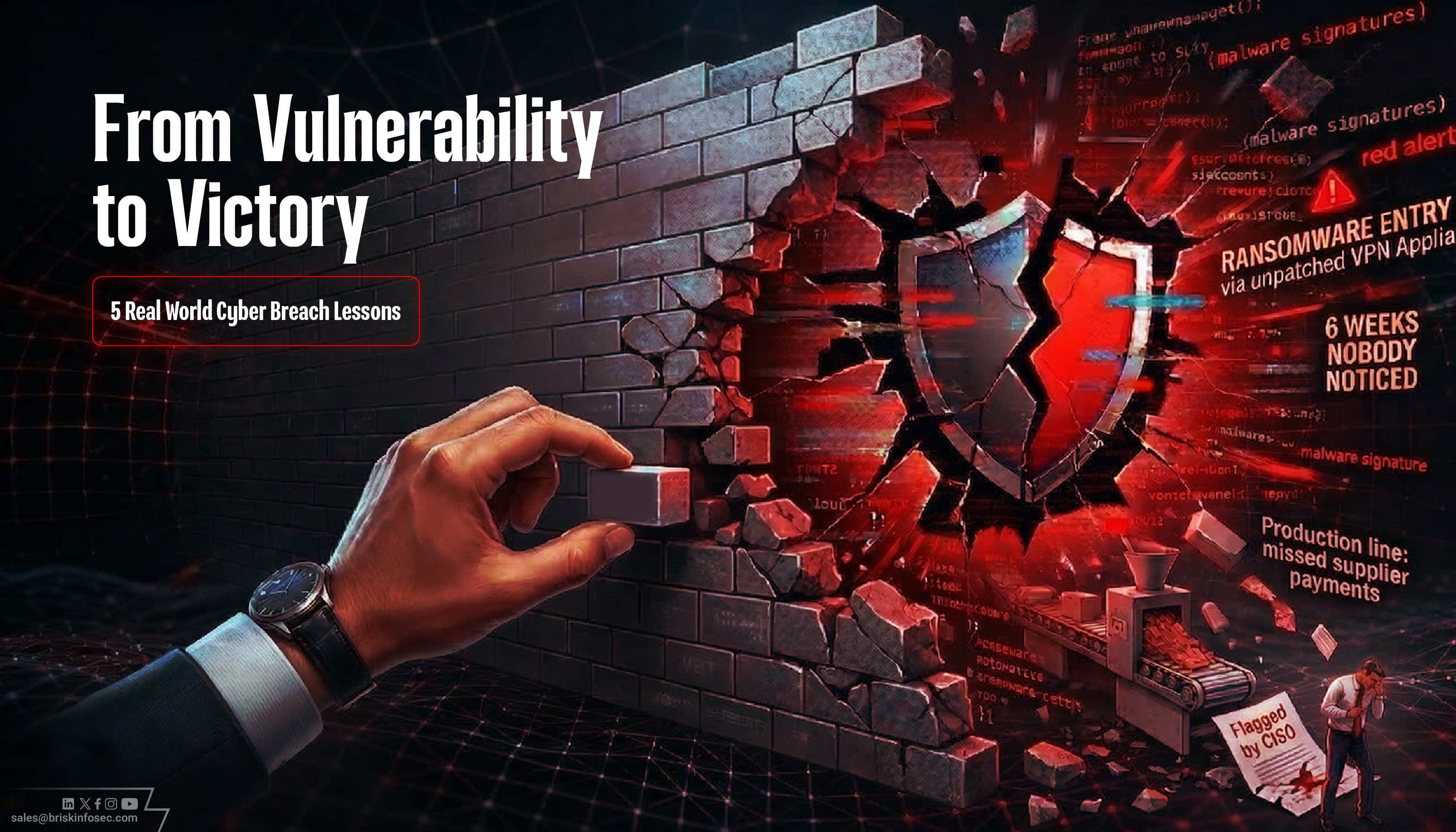
Introduction: The Call Nobody Wants to Receive
It was 2:17 AM on a Tuesday when the CFO of a mid-sized manufacturing company got the call. Their ERP system the backbone of procurement production scheduling and supplier payments was locked. A ransomware strain had quietly infiltrated the network six weeks earlier through an unpatched VPN appliance. Nobody had noticed. The attackers had been watching mapping and waiting. In the span of 72 hours the company lost access to 11 years of operational data ground three production lines to a halt and triggered a cascade of missed supplier payments that rattled investor confidence for the next two quarters.
The breach didn't happen because the company lacked a firewall. It happened because the CISO had flagged the VPN vulnerability in a quarterly report that the CEO had skimmed and set aside. It happened because "we'll patch it next sprint" became "we'll patch it next quarter." It happened in short because of small ignorance.
This is the central thesis of Vulnerability to Victory: The Cybersecurity Playbook (2024) written by Arulselvar Thomas Founder of Briskinfosec Indias only dual CREST approved cybersecurity company. Launched at GITEX Dubai and Search Chennai and distributed as a giveaway to over 2000 business leaders the book doesn't read like a technical manual. It reads like a warning. It's a wakeup call written for CEOs CFOs COOs and board members who believe cybersecurity is ITs problem right up until the moment it becomes everyone’s.
Covering the top 20 cyber threats facing businesses today complete with real case studies from manufacturing financial services and e commerce industries the book makes one argument repeatedly. The gap between a secure business and a breached one is rarely a technology gap. It's a leadership gap.
In this post we distill five of the most powerful lessons from the V2V framework lessons that apply directly to your organization starting today.
Lesson 1: Small Ignorance Leads to Big Breaches
There's a dangerous myth in boardrooms that a cyber breach is a dramatic Hollywood style event hooded hacker launching a precision strike against a high value target. The reality is far more mundane and far more preventable.
Consider the fictionalized but achingly realistic story of PrecisionMech Industries a Tier 2 automotive parts manufacturer. Their IT team had been running a legacy SCADA system the software controlling their CNC machines on Windows 7. End of life. No patches. No vendor supports. The security team had submitted four separate requests over 18 months to upgrade the system. Each request was deferred. "We can't afford the downtime" the COO said. "It's an internal system anyway it’s not connected to the internet."
Except it was. A junior IT admin had enabled remote access during the COVID 19 era to allow the maintenance vendor to log in from home. Nobody had disabled it afterward. Nobody had audited it. A threat actor discovered the open RDP port brute forced a weak credential in under four hours moved laterally across the network and exfiltrated three months of production blueprints before deploying ransomware on their way out.
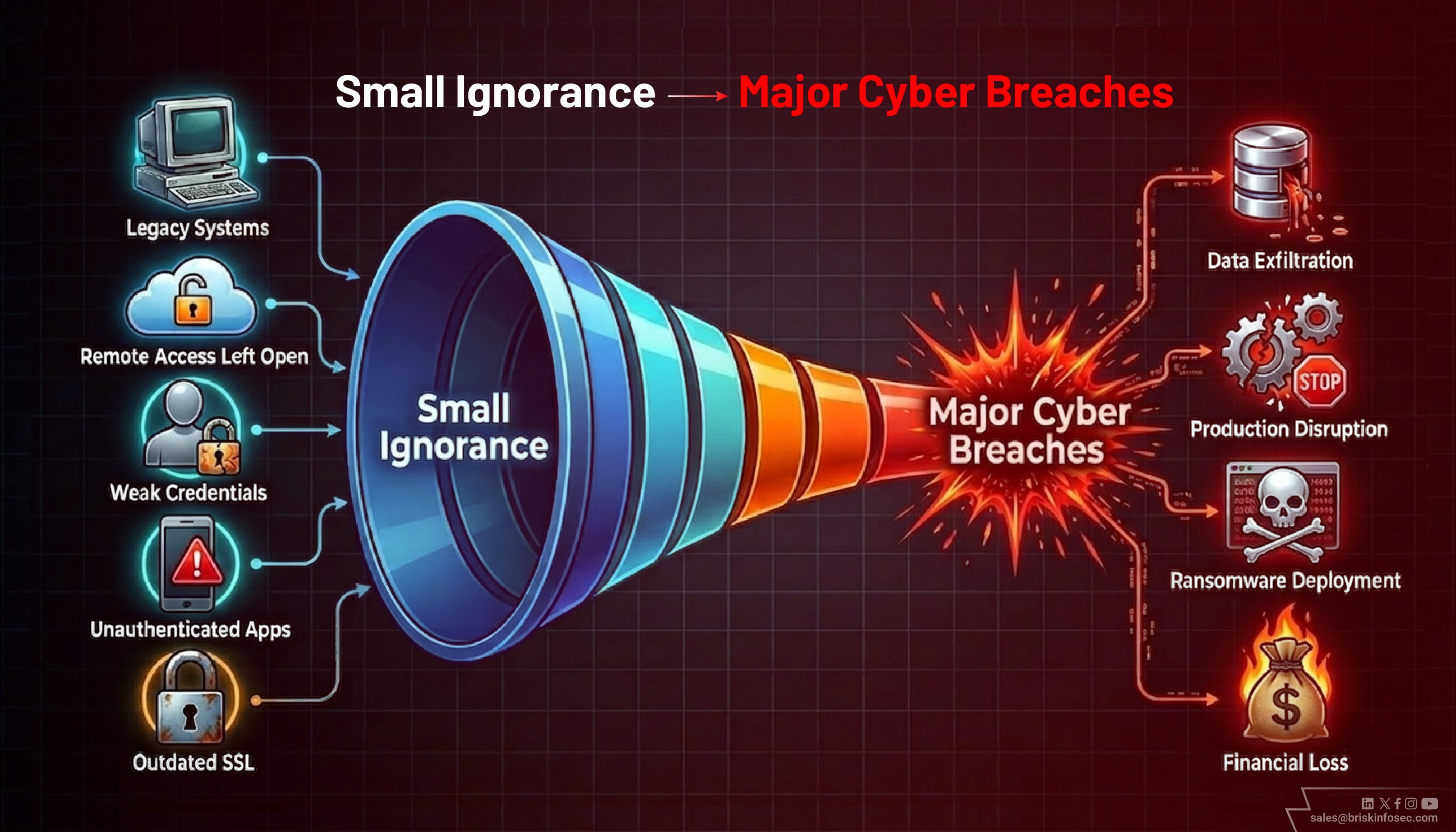
Vulnerability to Victory documents patterns like this across industries and arrives at a consistent finding. Most breaches exploit gaps that were already known. They succeed not because attackers are sophisticated but because defenders are distracted or dismissed.
In Briskinfosec's VAPT (Vulnerability Assessment and Penetration Testing) engagements the most common critical findings aren't zero-day exploits. They're default credentials left on network devices. They're internal applications with no authentication. They're outdated SSL certificates on customer facing portals. They're open ports that no one remembers enabling. Every single one of these is a "small" oversight. Every single one of them has been the entry point for a major breach.
The V2V framework is unambiguous. There is no such thing as a minor vulnerability in a connected environment. Every unaddressed gap is a door left open. The question is simply which adversary finds it first.
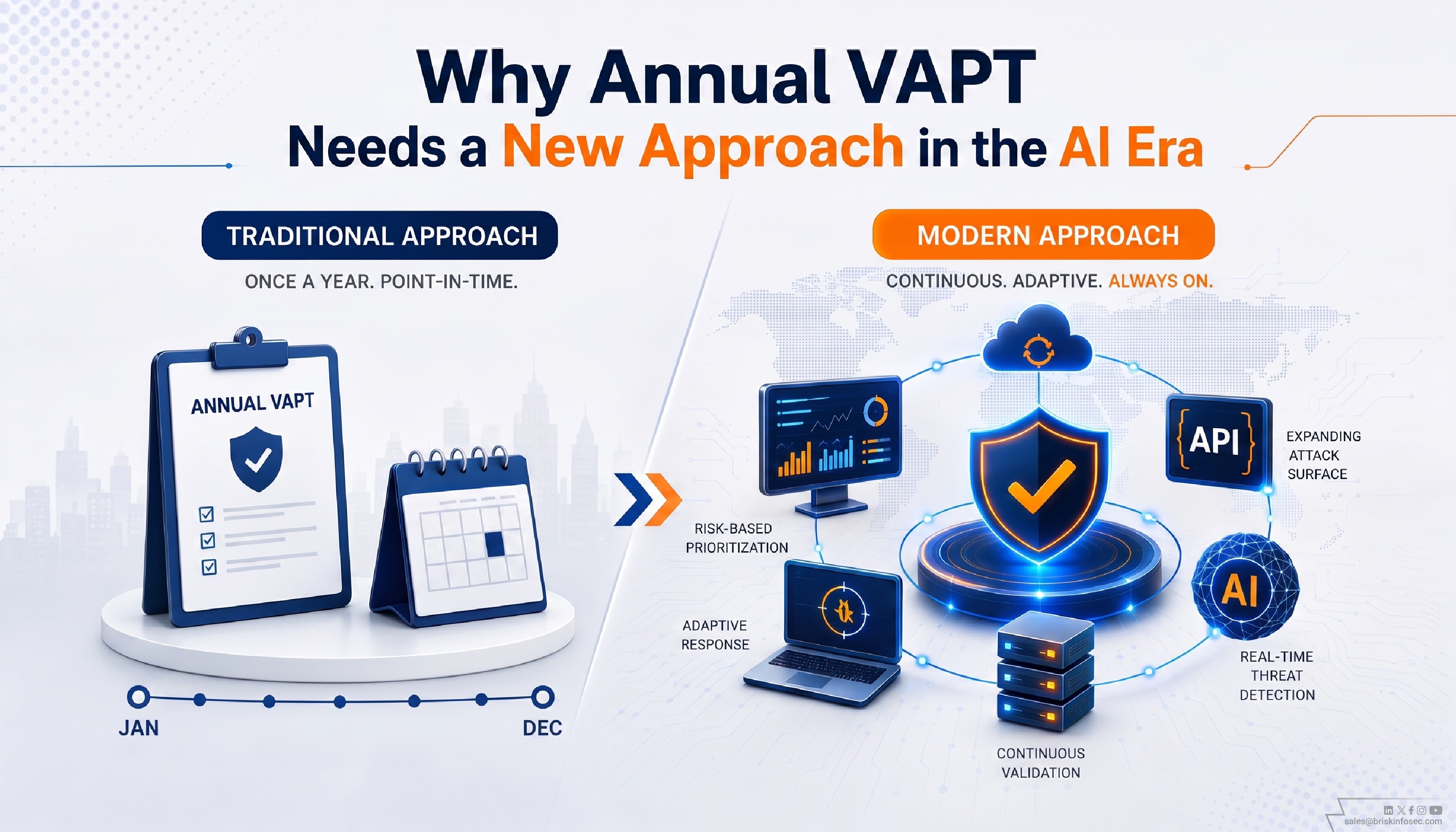
What to do now: Commission a full scope VAPT assessment that covers your network perimeter internal systems web applications and cloud infrastructure. Don't wait for a scheduled review cycle. Patch velocity matters. So does the organizational culture that determines whether a security finding gets acted on in 48 hours or 18 months.
Lesson 2: The Wall of Shame Is Closer Than You Think
Vulnerability to Victory introduces one of its most memorable concepts early. The Wall of Fame versus the Wall of Shame. The Wall of Fame belongs to organizations that treat cybersecurity as a strategic capability companies where the security posture is strong tested and continuously improved. The Wall of Shame belongs to everyone else. And according to Thomas most organizations are closer to the Wall of Shame than they realize.
Nowhere is this more viscerally illustrated than in the financial sector.
Imagine Horizon Finance Co. a regional NBFC (Non-Banking Financial Company) with a respected 22-year reputation in the SME lending space. Their mobile app launched two years ago to compete with fintech challengers had a flaw in the API layer. Its exposed customer account balances and transaction metadata to any authenticated user not just the account holder. A security researcher discovered it. So unfortunately, did someone else.
Before Horizons team could respond a data broker was selling their customer records on a dark web forum. The breach itself exposed 140000 records names loan amounts payment histories. Regulators took notice. A news cycle ran for 11 days. The company's loan disbursals dropped 34% in the subsequent quarter as SME borrowers chose competitors. Their NPS score which had been climbing steadily collapsed. Two senior executives resigned. The cost of the remediation the regulatory fines the crisis communications firm and the customer acquisition effort to rebuild trust totalled nearly four times what a comprehensive security program would have cost over the same two-year period.
This is the Wall of Shame. It's not just a data breach notification. It's a reputation event. And in financial services reputation is the product.
The V2V book documents this cascading effect in detail. How a single breach doesn't just damage the company that was breached it damages their customers their partners and the regulatory trust that the entire sector depends on. The reputational half-life of a data breach now extends for years amplified by social media data journalism and a growing population of privacy aware consumers.
The inverse is also true. Organizations that have publicly invested in certifiable demonstrable security CREST approved penetration testing ISO 27001 SOC 2 regular third party audits are increasingly winning procurement decisions partnership deals and enterprise contracts on the strength of that security posture. The Wall of Fame has a commercial value that most finance teams have never put on a spreadsheet.
What to do now: Audit your external facing applications particularly mobile apps and APIs against OWASPs API Security Top 10. If you haven't had a third-party penetration test conducted by a CREST certified team in the last 12 months you cannot confidently say you're not already on the Wall of Shame. You simply haven't found out yet. Also read our post on application layer attacks that have persisted for decades many of the vulnerabilities in the Wall of Shame incidents share the same root cause.
Lesson 3: CXO Psychology Why Leaders Underestimate Cyber Risk
Here is a pattern Arulselvar Thomas observed repeatedly in the research behind Vulnerability to Victory and which Briskinfosec's consulting teams have validated across hundreds of client engagements. The people most responsible for managing organizational cyber risk are frequently the least informed about it and the most resistant to being informed.
This isn't a character flaw. It's a structural one.
Most of today’s C suite was built for a world where technology was a support function. The CEO focuses on growth the CFO on cost control the COO on operational efficiency. Cybersecurity doesn't fit neatly into any of these categories. It doesn't generate revenue. It doesn't reduce headcount. Its value is almost entirely in what doesn't happen and humans are notoriously bad at assigning value to non-events.
The result is a predictable pattern that plays out in organizations of all sizes. The CISO presents a quarterly security report. It's dense with technical terminology CVE scores threat vectors attack surfaces. The CEO nods. The CFO wonders whether the budget line can be trimmed. The COO asks if this is going to delay the new ERP rollout. The report is filed. The patches remain undeployed.
The V2V book names this the Security as Cost Trap. When security is framed as a cost it competes with every other cost in the organization. When framed as risk mitigation or better as competitive infrastructure it changes the calculus entirely.
Consider the framing difference. "We need ₹40 lakhs for a VAPT program" is a cost. "We are currently exposed to a class of vulnerabilities that based on our industry peer benchmarks carry a 1 in 3 probability of a breach event that would cost us ₹8–12 crores in direct and indirect losses within 24 months" is a risk management decision. One is an expense. The other is a hedge.
Vulnerability to Victory dedicates significant attention to CXO communication strategy how security leaders can reframe their message in the language of risk opportunity cost and strategic positioning. This isn't manipulation. It's translation. Cybersecurity professionals and business executives often speak entirely different languages. The breaches happen in the gap between them.
There's a reason that books like V2V are endorsed by figures like Amar Prasad Reddy a prominent BJP functionary and cybersecurity advocate. Cyber risk is no longer a technical topic. It's a governance topic. It's a boardroom topic. It's a national resilience topic.
What to do now: If your executive team isn't receiving a monthly cyber risk summary that translates technical findings into business impact language that's your first action item. Build a security risk register that quantifies exposure in financial terms. And if you haven't read our analysis of how AI is reshaping the threat landscape for CISOs that's a mandatory read for every member of your leadership team.
Lesson 4: The 5 Layers of Security Youre Probably Missing
Most organizations think about cybersecurity in layers firewall antivirus maybe a SIEM. Three layers perhaps four. Vulnerability to Victory argues for five and the gaps in the conversation tend to be the most dangerous ones.
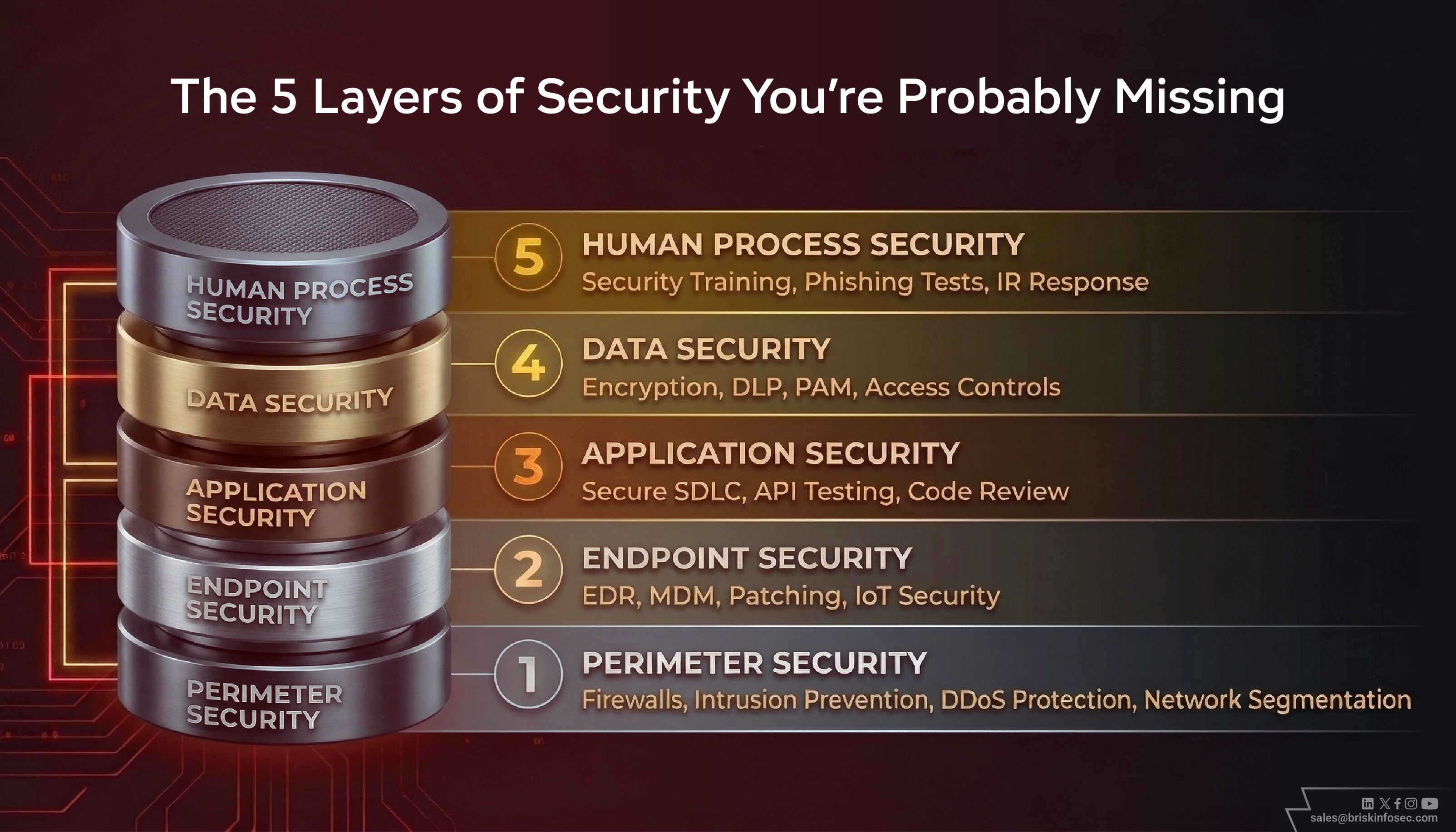
The V2V five-layer security model covers
Layer 1 - Perimeter Security
The outermost ring firewalls DDoS protection WAFs network segmentation and secure remote access (VPN ZTNA). Most organizations have something here. The question is whether it's configured correctly updated regularly and tested against real world attack techniques. A firewall with misconfigured rules is worse than no firewall it creates false confidence.
Layer 2 - Endpoint Security
Every laptop mobile device server and OT IoT device is a potential entry point. Endpoint Detection and Response (EDR) mobile device management (MDM) and rigorous patch management aren't optional extras. In manufacturing and industrial environments where legacy OT equipment runs on outdated OS versions this layer is routinely where attackers get their foothold.
Layer 3 - Application Security
Applications are where business logic lives and where most breach vectors now exist. The OWASP Top 10 hasn't changed dramatically in 20 years because the vulnerabilities it documents keep reappearing in new applications. Secure SDLC practices API security testing code review and regular application layer VAPT are the non-negotiables of Layer 3. Our post on decade old application attacks explores why these threats refuse to die.
Layer 4 - Data Security
Where your data lives how it moves and who can access it are the questions Layer 4 answers. Encryption at rest and in transit data loss prevention (DLP) privileged access management (PAM) and robust identity governance are the components of this layer. Most breaches ultimately terminate in a data exfiltration event but the data theft is the result of failures in Layers 1 2 or 3. Protecting data means protecting everything upstream of it.
Layer 5 - Human Process Security
This is the layer most organizations invest the least in and suffer the most from. Phishing accounts for the first stage of the majority of successful breaches. Security awareness training simulated phishing exercises clear incident response procedures and a culture of security accountability these aren't soft investments. They are the last line of defense when every other layer has been bypassed. The V2V book documents case after case where a well-trained employee caught an attack that technology missed entirely.
Layer Security Quick Check Checklist
Use this as a rapid self-assessment for your organization:
☐ Has your perimeter been penetration tested by a CREST certified team in the last 12 months
☐ Do you have an MDM policy covering 100% of devices including personal devices used for work
☐ Have your customer facing applications been tested for OWASP Top 10 vulnerabilities this year
☐ Is sensitive customer and business data encrypted both at rest and in transit
☐ Has your entire workforce completed security awareness training with phishing simulations in the last 6 months
☐ Do you have a documented tested incident response playbook
☐ Is your Zero Trust Architecture roadmap defined and in progress
If you answered "No" or "Unsure" to more than two of these your five layer security model has gaps that adversaries can and will exploit.
What to do now: Map your current security investments against each of these five layers. Identify the gaps. Prioritize remediation based on threat likelihood and business impact. Then test. The Briskinfosec Red Team vs. Blue Team vs. Purple Team framework one of our most read posts with over 60000 views is an excellent reference for understanding how to operationalize this testing across all five layers.
Lesson 5: GRC Is Not Just Compliance Its Competitive Advantage
If there's a single chapter in Vulnerability to Victory that separates it from every other cybersecurity book written for business leaders it's Chapter 21 Strategy Development. Because while Chapters 120 document threats Chapter 21 argues something that most security frameworks stop short of saying plainly. Cybersecurity is a strategic capability and GRC is its operating system.
GRC Governance Risk and Compliance is often discussed in the context of audits certifications and regulatory checkboxes. SOC 2 Type II for the cloud contract. ISO 27001 for the enterprise procurement. GDPR compliance for the EU expansion. These are all real requirements and they matter. But treating GRC as a compliance exercise is like treating fitness as something you do only when your doctor tells you to. It misses the point entirely.
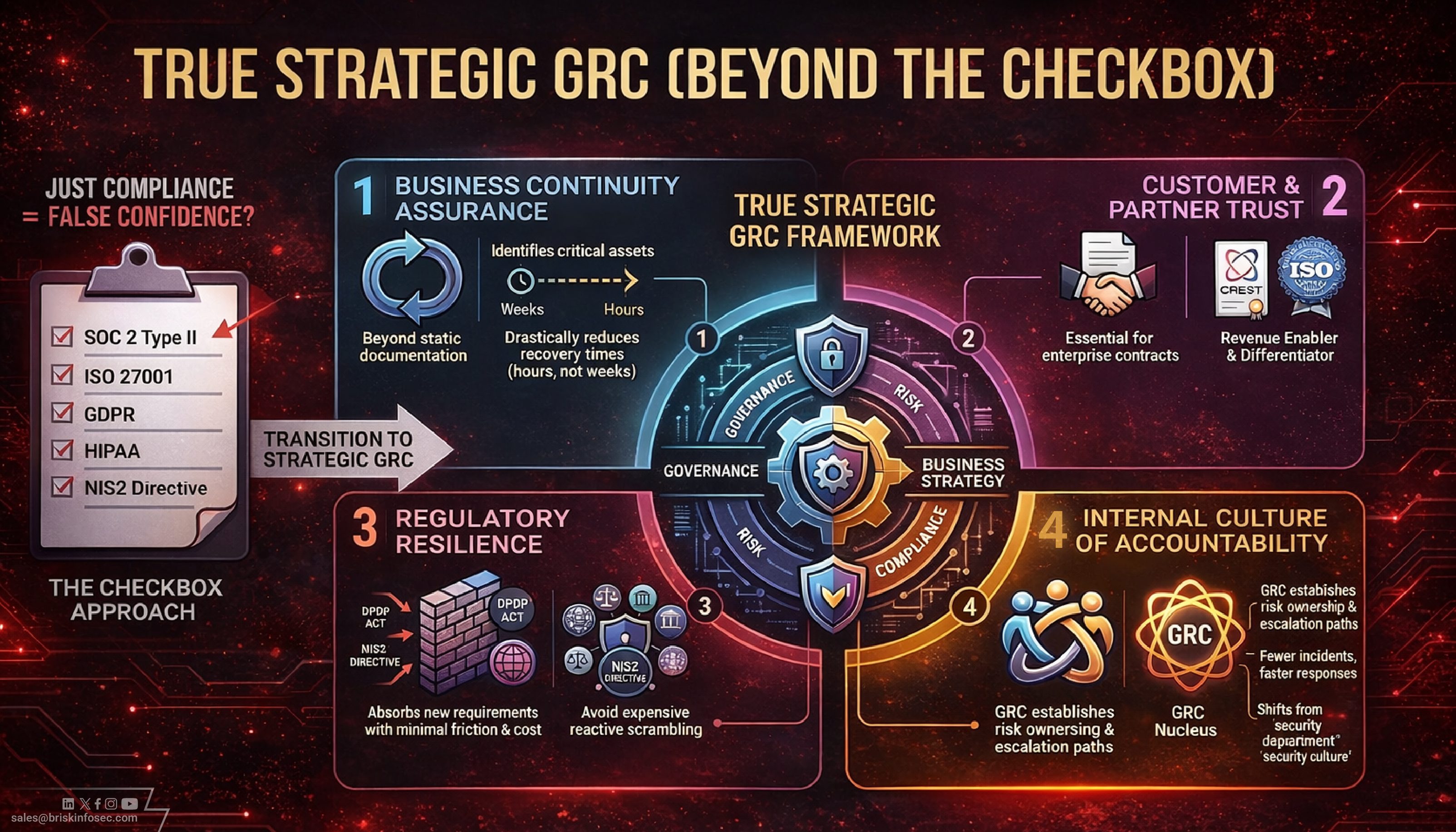
Here's what GRC done right actually delivers
Business continuity assurance - A mature GRC framework means your organization has identified its critical assets assessed its threat exposure and built controls that are monitored and tested continuously. When an incident occurs and it will your recovery time is measured in hours not weeks.
Customer and partner trust - Enterprise customers financial institutions and government procurement bodies increasingly require demonstrable security assurance before signing contracts. CREST approved penetration testing certificates ISO 27001 certifications and regular third-party audit reports are becoming table stakes for B2B contracts above a certain deal size. Your GRC maturity is quite literally a revenue enabler.
Regulatory resilience - As Indias DPDP Act (Digital Personal Data Protection Act) the EUs NIS2 Directive and sector specific regulations continue to tighten globally organizations with immature GRC programs will face increasing regulatory exposure. Those who have invested in GRC infrastructure will absorb new requirements with minimal friction. Those who haven't will scramble and scrambling is expensive.
Internal culture of accountability - GRC isn't just an external signal. Internally it establishes who owns what risk how decisions get escalated and what happens when a control fails. Organizations with strong GRC cultures report fewer internal security incidents faster incident response and higher security investment ROI. The V2V book frames this as the difference between "security as a department" and "security as a culture."
Briskinfosecs position as Indias only dual CREST approved company is not just a credential it’s a framework commitment. CREST certification requires that penetration testing teams demonstrate technical competency methodological rigor and professional ethics through independent examination. When a CREST certified team issues a finding, it carries evidentiary weight that a non-certified assessment simply cannot. For organizations managing GRC programs that require auditable credible security testing that distinction matters enormously.
Chapter 21 of Vulnerability to Victory offers a practical strategy development framework. Starting from an honest assessment of current security maturity mapping to a target state building a phased roadmap and building the governance structures that ensure momentum doesn't stall when the CISO changes or the budget cycle gets difficult.
What to do now: If your GRC program exists only as a spreadsheet that gets updated before an audit it's time to rebuild it as a living operational framework. Start by defining your crown jewels the assets whose compromise would cause maximum business impact and work backward from there.
How to Start Your Journey from Vulnerability to Victory
The gap between reading this post and actually improving your security posture is where most organizations get stuck. Intention without execution is just risk with extra steps. Here is a concrete starting point:
Step 1: Know Your Current Exposure
Download the Briskinfosec Threatsploit Adversary Report a research backed intelligence report that documents the most active threat actors malware families and attack techniques targeting industries like yours. It's the fastest way to benchmark your organization's exposure against what's actually happening in the threat landscape right now. Download the Threatsploit Report here.
Step 2: Conduct a Credible Security Assessment
A self-assessment tool or vendor provided scan is a starting point not an answer. Commission a CREST certified penetration test across your priority attack surface external perimeter web applications internal network or a full red team engagement depending on your maturity level. You cannot fix what you haven't honestly found.
Step 3: Close Your Critical Gaps
Prioritize remediation based on exploitability and business impact not just severity scores. A critical CVE on an internet facing server used by your customers is more urgent than a high severity finding in an isolated development environment. Build a patch and remediation SLA that has executive accountability.
Step 4: Build the Governance Layer
Assign ownership. Create an Information Security Steering Committee that includes representation from the C suite. Define your risk appetite. Establish reporting cadences. Make security visible to leadership every month not just when something goes wrong.
Step 5: Train Your Humans
Technology doesn't click on phishing links. People do. Launch a continuous security awareness program that includes role specific training simulated phishing campaigns and clear escalation procedures. Make security everyones job description not just the security teams.
Step 6: Read the Playbook
Vulnerability to Victory covers all of this and more with real case studies practical frameworks and the kind of unvarnished honesty that most consultants won't put in writing. If your organization doesn't have copies on the desk of every member of your senior leadership team that's worth fixing.
Conclusion: The Playbook Already Exists Will You Use It
The manufacturing company at the start of this post? They recovered. Eventually. After 11 weeks of operational disruption ₹6+ crores in direct and indirect costs two executive resignations and a supplier relationship that never fully healed. They now have a mature security program. They run quarterly VAPT cycles. Their CXO team receives a monthly risk briefing. Their incident response plan has been tested twice. They are today a Wall of Fame organization.
But here's the uncomfortable truth. Every single lesson they learned the hard way is documented in Vulnerability to Victory. The book existed before their breach. The knowledge was available. The playbook was written. They just hadn't read it yet.
Arulselvar Thomas wrote Vulnerability to Victory: The Cybersecurity Playbook (2024) specifically because he kept seeing the same patterns the same blind spots and the same devastatingly preventable breaches across industries and geographies. Launched to thousands of business leaders at GITEX Dubai and Search Chennai the book is now in the hands of executives who are actively using it to build better security strategies.
FAQ
1. What is the main thesis of Vulnerability to Victory by Arulselvar Thomas?
Vulnerability to Victory argues that most cyber breaches result from small preventable oversights and leadership gaps not technology failures. Written by Briskinfosec founder it uses real case studies from manufacturing finance and e commerce to show how organizations move from Wall of Shame breaches to Wall of Fame security cultures.
2. What are the 5 layers of security in the V2V framework?
The V2V model includes Perimeter Security (firewalls WAF) Endpoint Security (EDR MDM) Application Security (OWASP VAPT) Data Security (encryption DLP) and Human Process Security (training phishing simulations). Briskinfosec recommends CREST certified testing across all layers.
3. How does small ignorance lead to major cyber breaches?
Small oversights like unpatched VPNs default credentials and unaudited remote access enable 90% of breaches per V2V research. Briskinfosec VAPT finds these daily proving known vulnerabilities become attack doors when ignored.
4. Why is Briskinfosec the best for CREST certified VAPT?
Briskinfosec is Indias only dual CREST approved company for VA and PT delivering globally validated assessments. Our testing covers networks apps APIs and cloud uncovering gaps compliance teams miss.
5. How does GRC become competitive advantage per V2V?
GRC builds business continuity customer trust regulatory resilience and security culture turning cybersecurity into revenue enabler. V2V Chapter 21 provides roadmap for CISOs to align security with C suite priorities.